At a glance
-
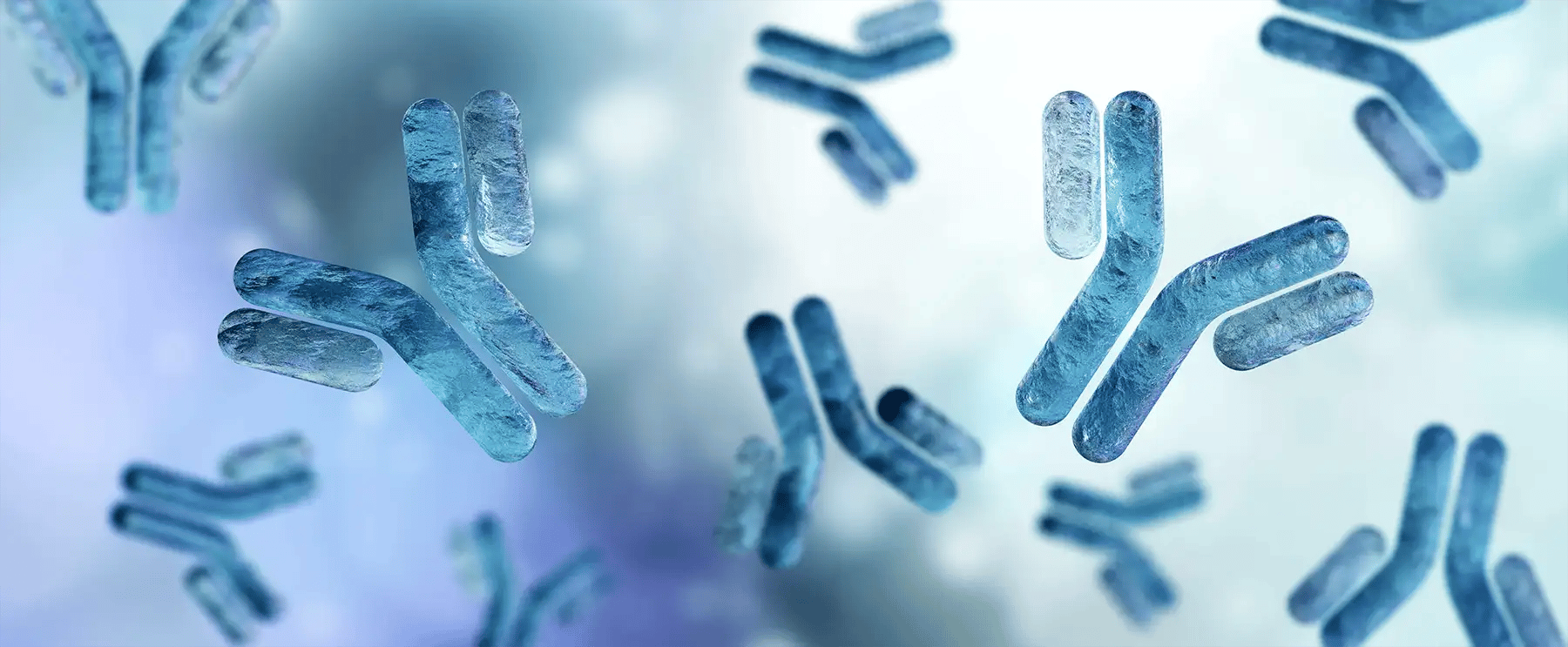
A bispecific antibody binds two different targets with one molecule. The hard part is assembly: with two different arms, the antibody’s chains can pair the wrong way and produce non-functional molecules.
-
Platforms handle this differently. Some drop the natural IgG structure, and some force every arm onto a shared light chain, which limits the binders you can use. A third approach engineers the constant domains so the right chains pair on their own.
- Discovery quality depends on testing the real, final-format molecule instead of a simplified stand-in. Screen in the final format and the data you pick a lead on is the data that moves into manufacturing.
- Three numbers tell you whether a platform makes developable molecules: yield, purity, and developability. The Invenra B-Body platform typically delivers 0.1-1 mg/ml transient expression, yields 6–11 g/L, and achieves >95% purity after a two-step purification process.
- Format matters. Whether each arm binds once or twice (1×1, 2×1, 2×2) can change potency and manufacturability, and the right choice depends on your biology.
Bispecific antibodies do something a single antibody can’t: bind two targets within one molecule. Enough of them have reached the clinic that the format is now an established drug class, and more programs start every year.
The concept is straightforward. But making a bispecific that works as a drug is where some programs get stuck.
The hard part is execution on both the engineering and biological sides. A bispecific has to assemble correctly, express at a yield you can manufacture, and hold together through the path to the clinic. The commercially available antibody platforms solve (or attempt to solve) those problems in very different ways. Those differences matter more than any vendor website makes clear.
This guide is for anyone deciding how to make a bispecific or comparing one discovery platform against another. I’ll briefly cover the assembly problem every platform has to solve, how the molecules get discovered, and the specific numbers worth asking a provider for before you commit.
The challenge of bispecific discovery: Two arms, wrong pairs
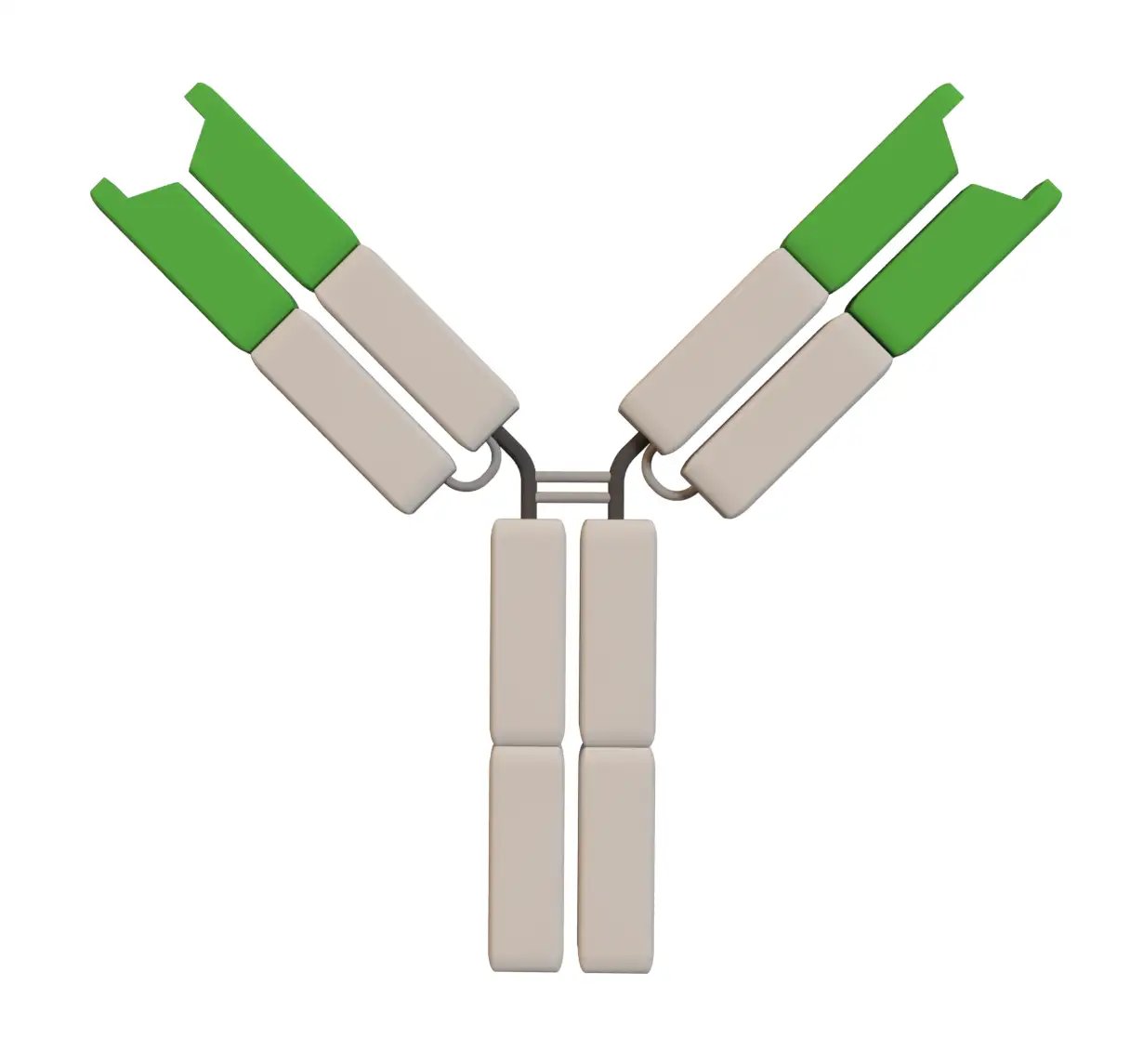
An antibody is built from four chains, two heavy and two light, and each arm is a heavy chain paired with its matching light chain. In a normal antibody, the two arms are identical, so there is only one correct way for the chains to come together.
In a bispecific, the two arms are different, and now the chains can mix and match. A heavy chain from one arm can grab the light chain meant for the other. Do that across a batch and you get a mess of mispaired, non-functional molecules instead of the one you designed.
Add more variety and the number of wrong combinations climbs fast. Platforms deal with this in different ways, and the choice has consequences:
-
Some give up the natural antibody shape. They fuse fragments together or build scaffolds that are not quite an IgG. That controls assembly, but you lose what a real antibody gives you for free: a long half-life in the body and a manufacturing process that facilities already know how to run.
-
Others keep the IgG shape but force every arm onto a single shared, or “common,” light chain. That removes the mispairing question and narrows your options at the same time. You can only use binders that happen to work with that one light chain, so you may have to leave your best antibody on the table.
-
The third route keeps a real IgG and engineers the parts of the antibody that do not touch the target, so the correct chains pair on their own while the binding regions stay untouched. That is the approach behind the Invenra B-Body platform, and the section below on the platform explains how it works.
How bispecifics get discovered
Before you can build a bispecific, you need binders: antibodies that bind each of your two targets. Some teams have binders on hand, while others need to discover them. When discovery is required, there are two methods to choose from.
- In vivo methods immunize an animal and harvest the antibodies its immune system makes.
- In vitro methods, such as phage display, screen large libraries of human antibody sequences in a dish, with no animals involved. In vitro methods give you more control over the starting material and avoid the developability surprises that animal-derived sequences can carry.
Here at Invenra, we run in vitro discovery on more than 30 proprietary phage libraries, each holding over a billion primary clones, and screen them in parallel across more than 90 conditions.
Screening the real molecule
A lot of discovery screens a simplified version of the molecule, picks a winner, then reformats that winner into the real bispecific at the end.
The trouble is that reformatting can change how the molecule behaves. A pair that looks strong as a simple construct can express poorly, aggregate, or lose activity once it’s built into the final format. You find that out late, after you have already committed to it.
The alternative is to build and test the actual final-format molecule from the start, and to do it at enough scale that you can compare many candidates side by side.

At Invenra, we do this with a matrix.
Instead of testing arm pairs one at a time, the matrix expresses a grid of bispecific molecules in their final format, in parallel, and characterizes all of them. A typical matrix runs a 12×12 grid in two orientations, which is more than 250 individual molecules built and screened in a single campaign.
The data you use to pick a lead comes from the real molecule, so nothing important changes between screening and manufacturing. The process goes from binder to lead in about four months and returns a ranked set of top B-Body leads for you to review.
The scale shows up in the published data. In one validation, we expressed a 15×15 matrix of clinical-stage antibodies in 1 mL cultures and purified them in a single step.
Over 99% of the combinations met both purity and yield criteria in at least one orientation. Purity was measured by capillary electrophoresis, binding by Octet BLI, and correct assembly by mass spectrometry.
Separately, we've published an expression dataset of 549 protein samples, roughly 493 unique sequences, across six antibody formats from standard IgG1 to trispecific.
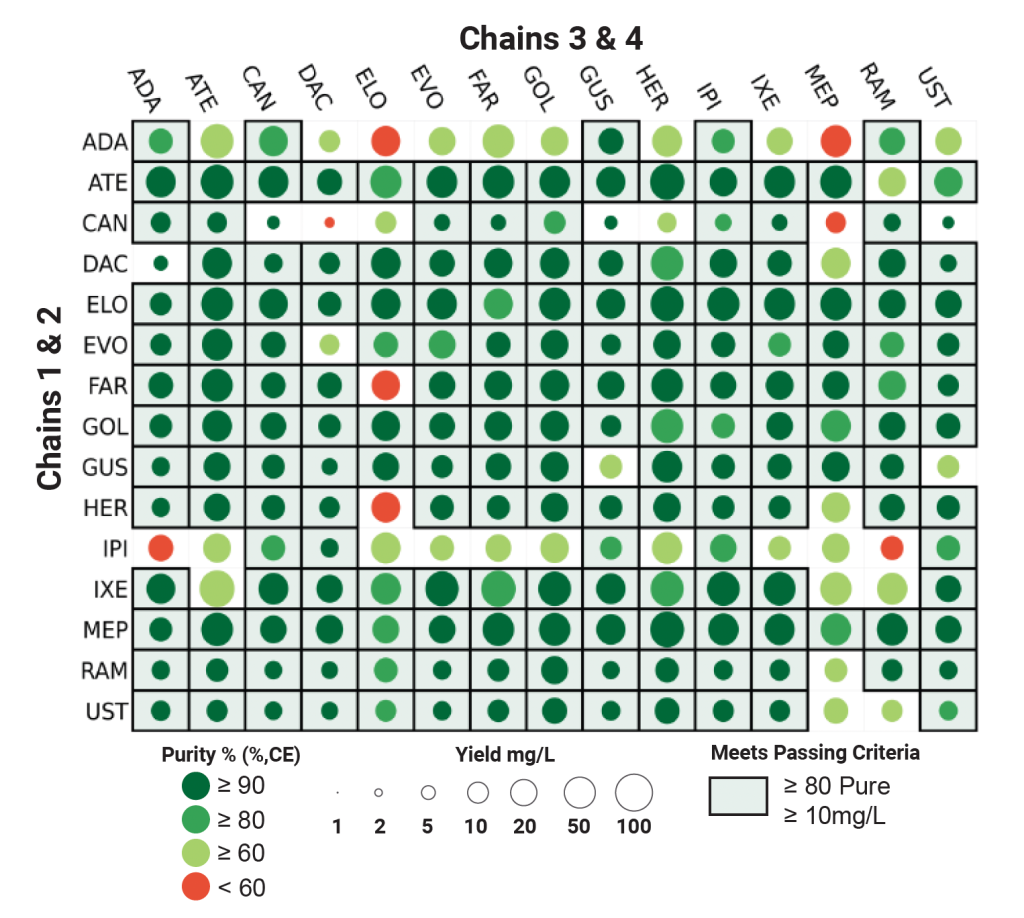
A 15×15 matrix of clinical-stage antibodies, expressed in 1 mL cultures and purified in a single anti-CH1 step. Dot color shows purity, dot size shows yield; over 99% of combinations met purity and yield criteria in at least one orientation.
The more real molecules you can test, the better your odds of finding one that works, and the more the data can guide the lead selection instead of guesswork.
What good bispecific performance looks like
An antibody-based drug is more than just antigen binding. You have to make it economically and at scale, and it must be stable enough to get it to patients.
A good bispecific antibody drug must deliver three traits: biological function, manufacturability, and dosing/stability.
Biological function: Beyond good binders
A drug must deliver the right biology, not just stick to the right antigen. It must be specific to its target to avoid off‑target effects and engage the right mechanism of action, whether that means killing through immune cells, driving internalization to deliver a toxic payload, or orchestrating a complex immune response.
New drugs can’t be tested in humans until very late in the development process. We rely on an expert team of drug developers using panels of predictive assays to read the signals early:
-
Rat PK for exposure and clearance
-
In vitro immune assays for polyreactivity and effector function
-
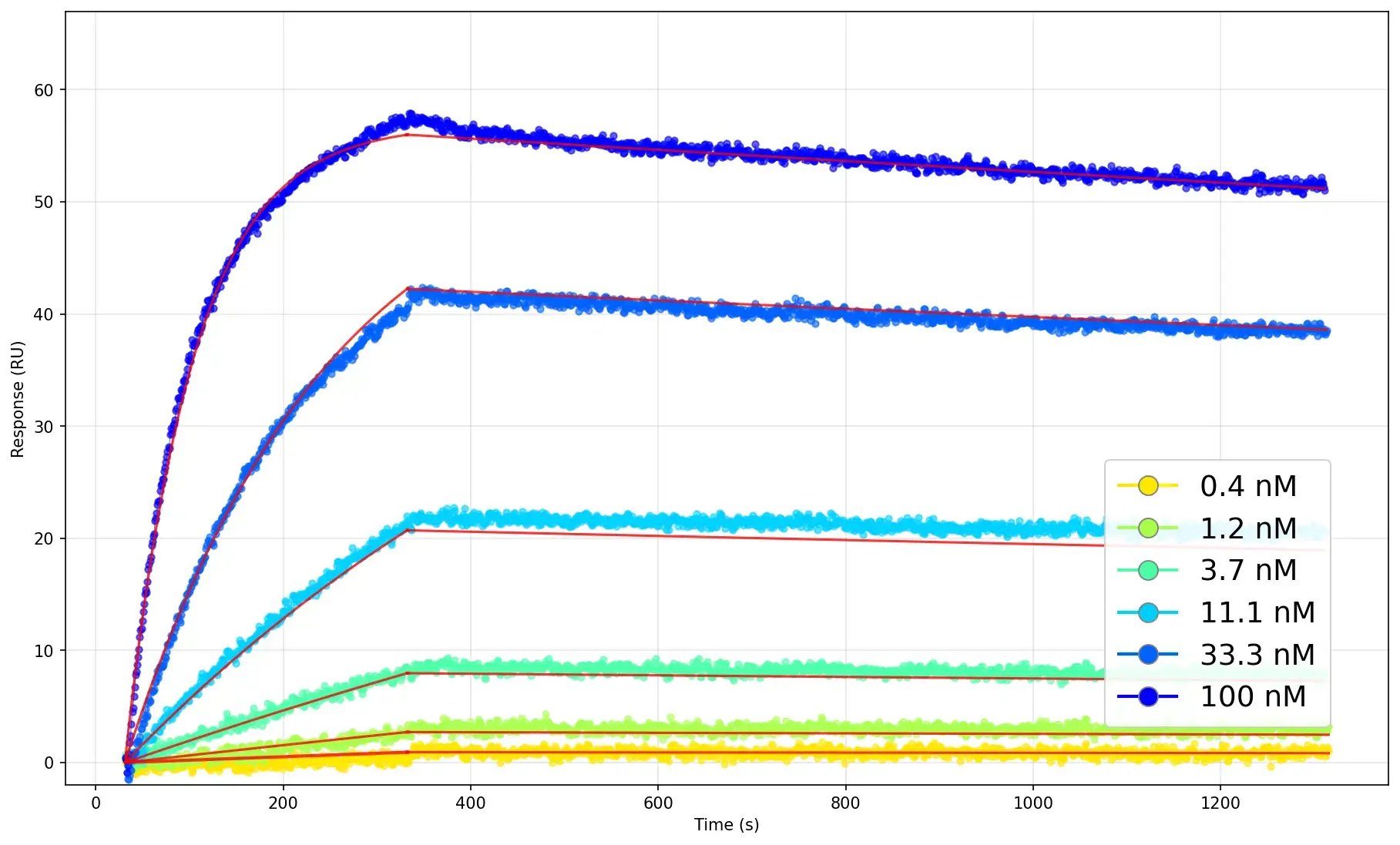
High‑resolution binding analysis on platforms like Carterra (see graph below) to map affinity, kinetics, and epitope coverage
Manufacturability: Can you make it?
For a global supply, the molecule must express at thousand‑liter scale and be produceable in prebuilt manufacturing facilities that use platform processes.
Change is expensive here. If your bispecific needs a bespoke upstream or downstream process, you will feel it in cost, risk, and timelines. We built the B‑Body platform to acknowledge this reality. It accommodates standard monoclonal antibody manufacturing, so the facilities needed to make your B‑Body are readily available.
To determine if a bispecific platform is suitable for drug development, three numbers matter: yield, purity, and developability.
Yield
Yield is the amount of antibody you get per liter of culture. It's a critical component of manufacturability.
B‑Body bispecifics typically deliver 6 to 11 g/L (the green bar in the graph below) from stable CHO cell lines. For comparison, a panel of other bispecific platforms averaged 2.4 g/L (grey). This is the highest‑expressing bispecific platform we're aware of, and it drops right into standard mAb‑like processes.
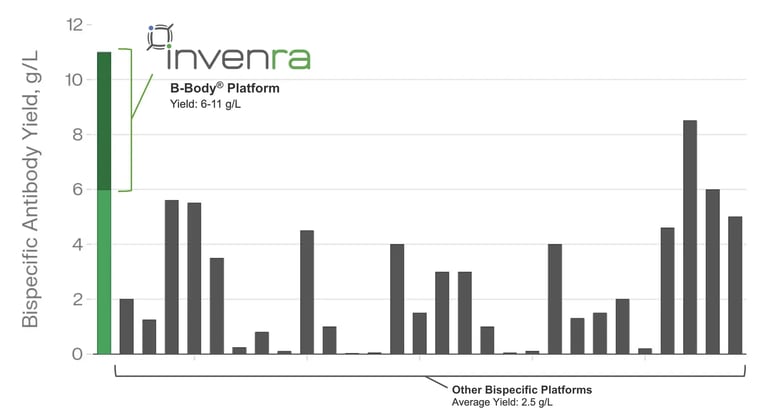
B-Body bispecific yield (green) against a panel of other bispecific platforms (grey). B-Body runs 6–11 g/L; the panel averages 2.4 g/L.
Purity
Purity is how clean the molecule comes out, and it determines how easily you can isolate the final product.
The B‑Body delivers >80% purity in a single purification step and nearly 100% in a standard two‑column process. The figure below demonstrates purity >95% for all formats, including 1×1, 2×2, 2×1, one‑arm, and an IgG1 control.
That single-step purity holds across formats: after polishing, size-exclusion purity lands at 90 to 95% or better across 1×1, 2×1, and 2×2.
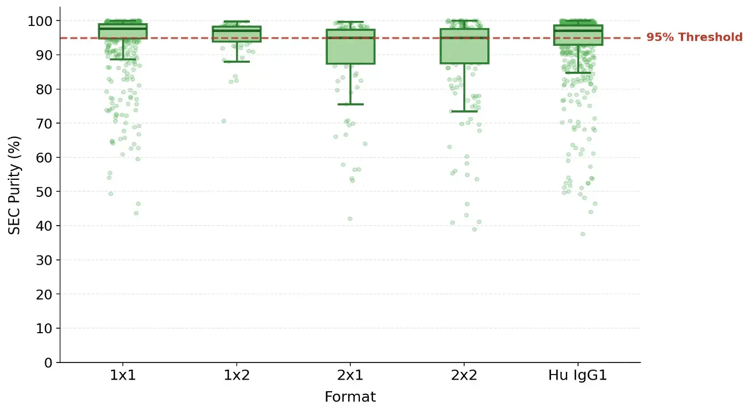
Size-exclusion purity by format, before polishing (grey) and after (green), across 1×1, 2×2, 2×1, trispecific, one-arm, and an IgG1 control. After polishing, purity lands at 90–95% or better.
Process‑focused developability
Manufacturability also depends on how the molecule behaves in the plant.
Highly specialized assays measure parameters like Tm, Tagg, thermostability, and aggregation potential. These are predictive of how a candidate will respond to shear, temperature shifts, and concentration steps in real manufacturing runs.
A molecule that scores well here moves smoothly into platform processes. One that doesn’t require special processes, which dramatically affect the cost of goods or timelines.
Storage, stability, and dosing: Getting to the patient
Being able to manufacture the drug isn’t good enough. You have to deliver it to the patient reliably using current processing and standard routes of administration.
Our B‑Body platform was built with this endpoint in mind. We can test solubility, viscosity, freeze–thaw behavior, long‑term storage, colloidal properties, post‑translational modifications, and more.
The goal is simple: make sure that the molecule you discovered can be formulated at practical concentrations and dosed in ways patients can live with.
The figure below shows viscosity versus concentration for two B‑Body molecules. Both stay within the subcutaneous dosing range (under the lower dashed line) at high concentration, which means they can likely be formulated for injection rather than for IV infusion, which is a real benefit for patient adherence and quality of life.
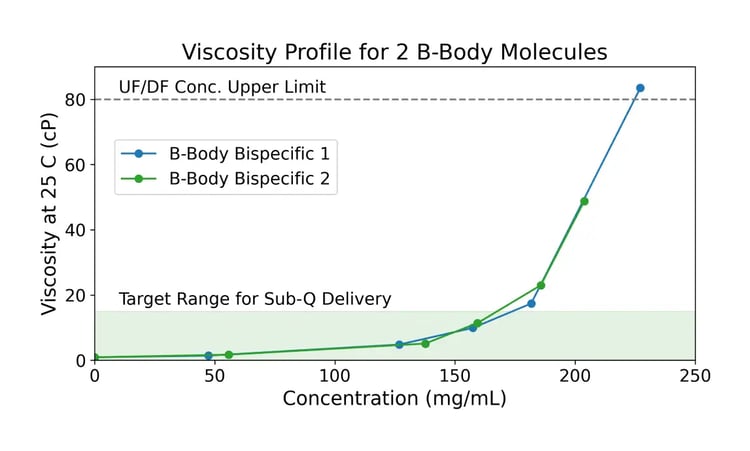
A drug that checks all three boxes—right biology, plug‑and‑play manufacturability, and patient‑friendly dosing and stability—is the one most likely to survive the long path from discovery to clinic.
Choosing a bispecific format
Not every bispecific has the same shape. The B-Body platform can build three different shapes, and the difference is how many times each arm binds.
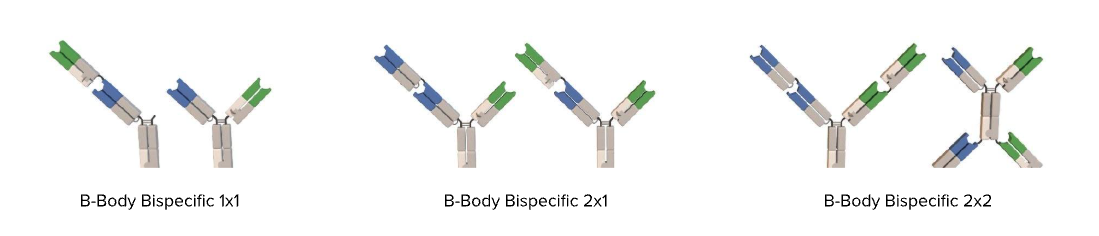
The three B-Body bispecific formats. Each colored arm marks a binding site for one of the two targets.
- A 1×1 binds each target once. It is the simplest and most IgG-like, with no avidity.
- A 2×1 binds one target twice and the other once, which gives avid binding where you want it.
- A 2×2 binds both targets twice. The higher valency formats bind more tightly and are more complex to make.
Which one fits depends on the biology:
-
How densely the target sits on the cell surface.
-
The therapeutic window you are aiming for.
-
What you can manufacture.
Because the platform tests formats in parallel in their final configuration, you can compare them on real functional data in weeks instead of committing to one on a hunch.
How the B-Body platform does it
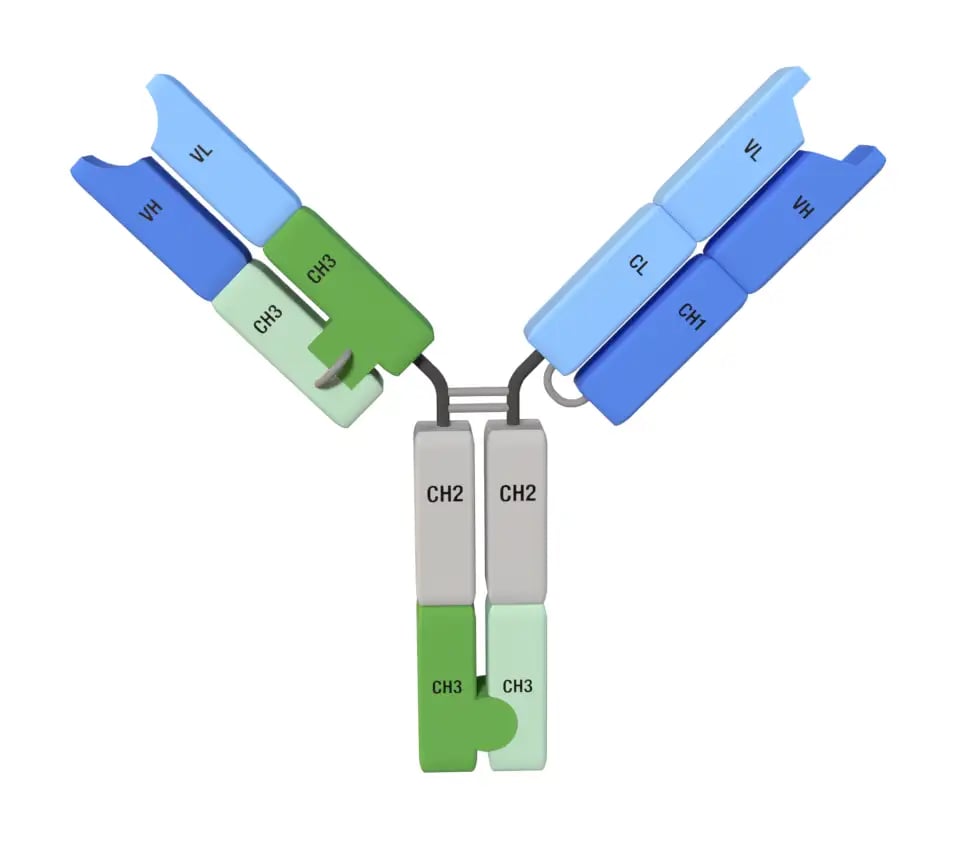
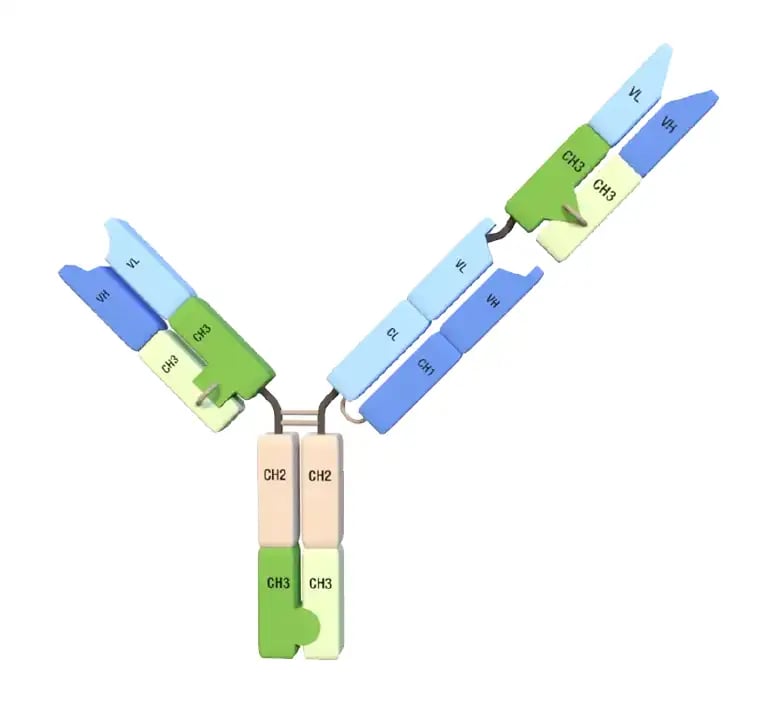
This is a good time to dive into the B-Body platform itself. B-Body keeps the human IgG and moves the engineering into the constant domains, away from the binding regions.
Three changes do the work:
-
A knobs-into-holes Fc makes the two heavy chains pair with each other rather than with themselves.
-
Proprietary CH3 domains replace the CH1 and CL in one Fab arm, so the correct light chain pairs on its own with no common light chain required.
-
And that same arm keeps a single CH1 domain, which allows one-step purification with an anti-CH1 resin.
Here’s what the B-Body scaffold looks like:
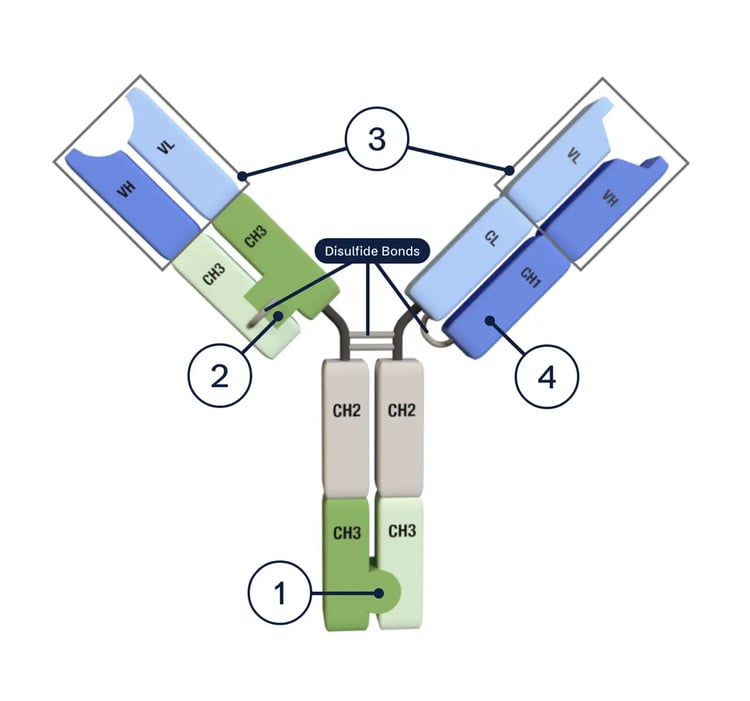
The B-Body scaffold. (1) knobs-into-holes Fc so the heavy chains pair with each other; (2) proprietary CH3 domains replacing CH1/CL in one Fab arm, so the right light chain pairs on its own; (3) plug-and-play variable domains from any source; (4) a sole CH1 domain that allows one-step anti-CH1 purification.
The result is a molecule that behaves like a normal antibody, works with binders from almost any source, and scales from bispecific to trispecific on the same architecture.
Because the binding regions are never re-engineered, the antibodies you bring in are the antibodies you actually test.
What you should get at the end
A bispecific discovery program should deliver more than a sequence. The output should be a molecule in its final, manufacturable format, with the data package behind it: expression, purity, developability, binding, and function.
That’s the difference between a molecule and a development candidate that is ready for cell line development. It’s the standard a bispecific discovery service should be held to.
If you're comparing bispecific platforms, ask these questions:
- Does it keep a real IgG?
- Can you use your own binders, or are you locked to a common light chain?
- Does it test the final molecule or a stand-in?
- And can it show you yield, purity, and developability data on real molecules, not just a diagram of the mechanism?
A platform that answers all four lets the biology, rather than the method, decide your lead. B-Body lets biology decide, and we’d love to show you more.
Talk to us
If you have two targets and want to see how B-Body would handle them, let’s start the conversation. We’ll walk you through the approach, the formats worth considering, and what the data would look like for your program.
Contact us »
Or start with the data: The B-Body Platform data sheet has the full yield, purity, and matrix screening data referenced above, including the 15×15 clinical-antibody results and the developability profiles. Download our B-Body data sheet »
 White paper
The Plug-and-Play Advantage of Invenra’s Multispecific Platforms
Invenra’s B-Body® and T-Body™ modular multispecific antibody platforms enable plug-and-play assembly and format-agnostic purification to deliver consistently high-purity bispecific and trispecific antibodies.