At a glance
- Bispecific platform choice is also a business-model choice. Fragment-based formats are widely available on straightforward fee-for-service terms, while many IgG-like platforms come with licensing obligations, milestones, or royalties. (At Invenra, we're changing that.)
- The right provider depends largely on what problem you need solved. Large CROs offer breadth, discovery specialists excel at finding binders, platform licensors provide access to proprietary architectures, and multispecific specialists focus more deeply on assembly, developability, and CMC challenges.
- Commercial terms deserve as much scrutiny as technical capabilities now. Before choosing a provider, understand who owns the sequences and data, what licensing obligations follow the molecule, and what changes if the program advances clinically.
- The final deliverable matters immensely. A purified molecule is not the same as a characterized lead candidate supported by expression, purity, developability, binding, and functional data.
- Invenra's B-Body® platform combines IgG-like architecture with broad binder compatibility and flexible geometry. Discovery and expression work is offered without milestones or royalties, with customers retaining ownership of their leads, sequences, and data. A commercial/clinical license is only required at IND.
Our guide to bispecific antibody platforms covers the format decisions you need to make when building bispecific antibodies: the main approaches and their pros and cons.
This is the companion guide to the other half of the decision. Once you know roughly what kind of molecule you need, you still have to decide who builds it.
Those two decisions can get tangled together, and that's the first thing worth addressing. It's important because the format you choose can determine the commercial terms you get. That connection isn't always obvious at the beginning, but it's important to understand before you start looking at your options.
The trade-off most people don't see coming
We encourage teams to try to look at the bispecific landscape by business model rather than by architecture. A pattern shows up quickly. Fragment-based formats, scFv and VHH constructs, and their Fc fusions are widely used, and many CROs can build them. You pay for the work; you get the molecule.
Human IgG-like formats are a different case. Many are IP-protected, and some are proprietary, held by the companies that developed them, and access is either limited or comes with milestones and royalties attached.
In the table below, we break down the current landscape of options by format category so you can compare them by their core design principle and function.
Table 1. Description of major bispecific Ab formats
|
Format Category |
Design Principle |
How It Works |
|
Fragment-based (scFv/VHH and Fc fusions) |
Minimize structural complexity by using small binding fragments instead of full IgG arms |
Single-domain or single-chain binders are linked directly or fused to an Fc region, avoiding the heavy/light chain pairing problem entirely by not using paired chains in the traditional sense |
|
Common light chain |
Solve heavy/light chain mispairing by removing the light chain variable |
Both binding arms are engineered to share one light chain, so any heavy chain can pair correctly, at the cost of requiring input antibodies to share or adopt that common light chain |
|
Electrostatic steering |
Solve heavy chain mispairing through charge complementarity |
Opposite charges are engineered into each heavy chain's constant region so that only the correct heavy chain pairs assemble, favoring proper pairing without altering the light chain |
|
Domain switching |
Solve chain mispairing by swapping domains between arms |
Selected domains from the heavy-chain and light-chain sides of one Fab are exchanged, creating structural asymmetry that forces correct heavy/light pairing while preserving each arm's native variable region |
|
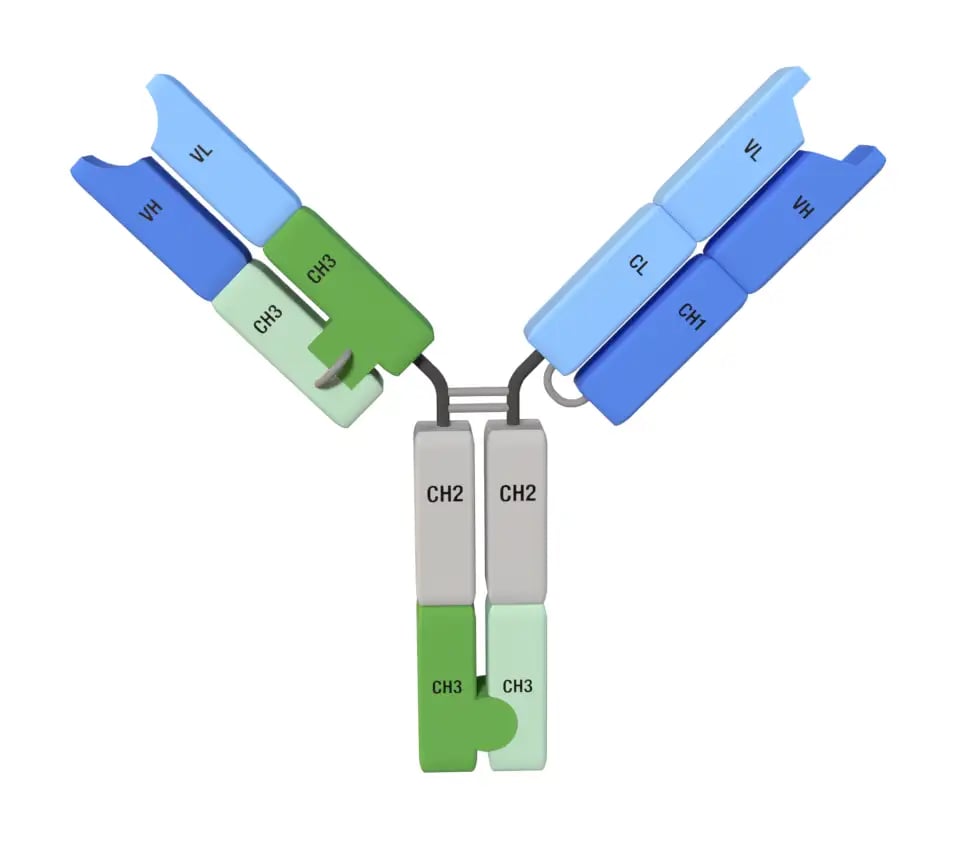
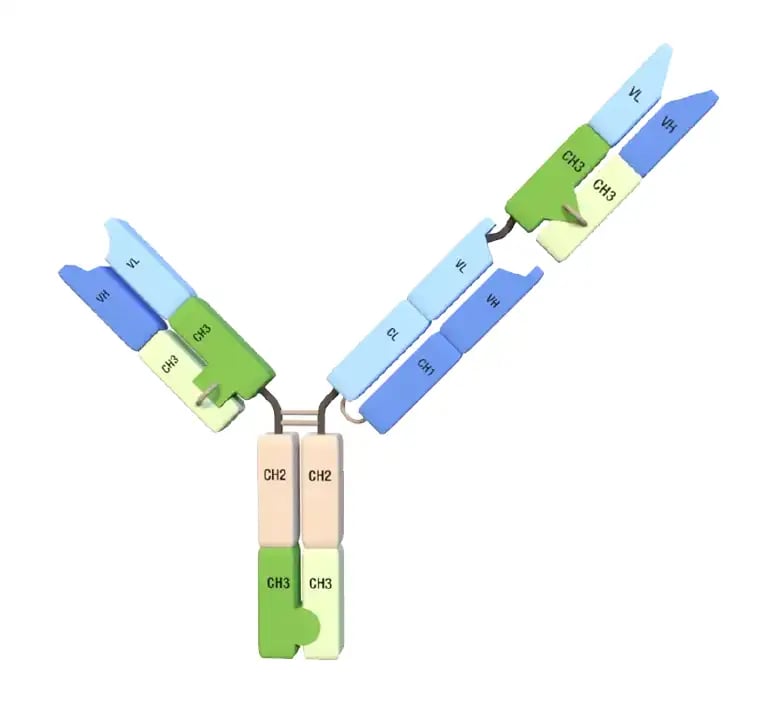
B-Body (Invenra's domain switching approach) |
Solve chain mispairing through domain substitution while preserving germline-native variable regions |
A proprietary CH3 domain-substitution mechanism enables correct pairing regardless of germline origin, without requiring common light chain engineering, while supporting multiple valency and geometry options (1×1, 2×1, 2×2) |
You can find molecules in the clinic utilizing any of these approaches. It's a terms-of-use consideration more than it is a quality consideration at this point.
If you want the least expensive, simplest commercial arrangement, the fragment formats will get you there. However, you must accept the trade-offs between developability and potential immunogenicity that we highlight in the next table below.
If you want a molecule that behaves like a real IgG, you may have to accept a licensing relationship with downstream economics attached, and often with an upfront commitment.
That trade is one reason why so many bispecific formats exist. When good platforms are expensive or unavailable, well-funded teams build their own. More than a hundred described platforms are partly a story of engineering creativity and partly a story of access.
The table below gives a quick summary of the current bispecific antibody service landscape and the advantages Invenra brings to it.
Table 2. Platform considerations for the main bispecific platforms
|
Platform consideration |
Fragment-based (scFv/VHH and Fc fusions) |
Common light chain |
Electrostatic steering |
Domain switching |
B-Body® bispecific |
|
Input mAb compatibility |
Requires binder reformatting, which can alter stability and developability |
Restrictive. Inputs must share a light chain or be engineered to share one |
Requires charge-engineered heavy chains and case-by-case developability assessment |
Generally flexible, but may require construct-specific engineering |
Works with all mAb binders, different light chains, and no variable-region engineering |
|
Geometry and valency |
Tandem additions increase size and complexity |
Higher valency usually requires extra fusions |
More complex formats add pairing and engineering burden |
Broadly flexible, but increasing complexity can increase development work |
Support for 1×1, 2×1, and 2×2 formats in one platform |
|
Discovery and optimization |
Linkers and scFv interfaces can drive aggregation and optimization cycles |
Shared-light-chain conversion adds redesign and revalidation work |
Heavy-chain steering can require substantial format-specific optimization |
Engineering needs can delay final-format testing |
Screens broad matrices directly in the final format in months; pairing minimizes optimization |
|
CMC and manufacturing |
Higher hydrophobicity and aggregation risk |
Yields and purification remain molecule-dependent after light-chain engineering |
Homodimers, charge variants, and product heterogeneity can complicate process development |
Yield, purity, and stability vary substantially by construct |
6–11 g/L fed-batch titers with standard mAb purification |
|
High-concentration formulation |
Aggregation and colloidal-stability risks can limit concentrated formulations |
Performance is molecule-dependent and inconsistently disclosed |
Charge design can create molecule-specific solubility and viscosity risk |
Charge design can create molecule-specific solubility and viscosity risk |
>150 mg/mL across multiple programs with low viscosity across 1×1, 2×1, and 2×2 formats |
Compared with single-domain platforms, the B-Body platform is typically more attractive due to its superior stability and IgG-like structure. Compared with common light chain, B-Body Platform works with any well-behaved mAb without the sequence constraints.
Also, B-Body is the only disclosed bispecific antibody platform we know of at the moment for which data confirms all of the following simultaneously:
- 6–11 g/L fed-batch titer
- Solubility consistently exceeding 150 mg/mL, with multiple programs reaching 200 mg/mL while maintaining low viscosity
- Demonstrated across 1×1, 2×1, and 2×2 formats
- Standard mAb-compatible purification (e.g., Protein A/CEX) to high purity
- At least one program in active Phase 1 clinical development
- Compatibility with mAbs regardless of germline origin
The kinds of bispecific antibody providers you’ll find right now
If we were to categorize the bispecific discovery space, there are a few main areas.
- Large full-service CROs. The advantage they bring is breadth and scale: they can take a program across many stages, and they have capacity you won't outgrow. But bispecific work is just one service line among many. If your project is straightforward and you prefer a single vendor across a wide scope, this might work.
- The platform licensors. These are the companies that developed an IgG-like format and licensed access to it. You're buying rights to a technology as much as buying work. Terms usually include licenses, milestones and royalties, and the relationship tends to be structured and long-term. If you need a specific format, here is how to get it.
- Antibody discovery specialists. These groups are focused on finding good binders, which is a genuinely different skill from assembling them into a working multispecific. Some also offer their own bispecific formats, frequently using common light-chain or single-domain approaches.
- Do-it-yourselfers. This is where teams try to reverse-engineer a platform using publicly available information. The problem is that the published information often doesn’t include special know-how or years of experience working with the platform. You’re left to feel around in the dark for a specific process.
- Multispecific specialists. A smaller group, including Invenra, whose work focuses on building and validating multi-arm molecules. The strongest argument for a specialist is that a bispecific fails in ways a monoclonal doesn't, and the failures are mostly due to assembly and CMC problems rather than binding problems.
None of these categories is the right answer on its own. What matters is which set of problems you're actually hiring someone to solve.
A few questions worth asking any antibody service provider
If you’re comparing providers in this space, here’s what you might want to ask.

1. What do you own when it's finished?
This is the first question, and it's often the last one people ask! Get specific here.
- Do you own the sequences outright?
- Are there downstream licenses, milestones, or royalties associated with the molecule?
- If you take the program to the clinic, does anything change?
- If you walk away, what can you take with you?
There's a related question that catches teams, too. If the provider's platform is IP-protected, your molecule may be inseparable from their technology, meaning your asset carries a license obligation for its commercial life. That may be entirely acceptable. But it should be a decision, not a discovery!
2. Who is actually doing the work?
In a large organization, the people who worked with you to start the program are usually not the ones running it, and the people running it are usually not the ones who developed the antibody platform. That distance matters most when something unexpected happens.
Ask who will be on your calls, whether you can talk to the scientists directly, and how decisions get made when the resulting data is ambiguous.
3. What can you see before you sign?
This is one of the most frustrating things we’ve noticed across our space that we specifically built ourselves for: transparency.
In the bispecific services space, a lot of events, even the most basic information, sit behind an NDA. Pricing in particular!
It's common to spend weeks and several meetings just to learn what a program costs.
We'd argue that's backward, and we publish our pricing for fee-for-service antibody discovery work for that reason. But even setting our own practice aside, what a provider shows you up front tells you something.
- Can you see representative data, not just a hand-picked best result?
- Can you see how the process actually works?
4. Where does the work happen?
Depending on your sensitivity around geopolitics, and if your program touches federal contracts or grants now or later, the provenance of your supply chain has moved from a preference to a diligence item, and it's reasonable to ask a prospective provider where the work is performed and who owns it.
Invenra is based in Madison, Wisconsin, and the work happens here. For some teams, it's critical to keep the work and data within the United States.
5. What are you handed at the end?
There's a difference between receiving a molecule and receiving a lead candidate.
A sequence and a binding curve are not the same deliverable as a characterized molecule in its final format with expression, purity, developability, and functional data behind it, ready for cell line development.
Ask what the data package will contain, specifically. Ask what happens if the lead doesn't hold up, and who decides which leads advance.
In our programs, the customer sees the full data set and picks the leads with us, because handing someone a ranked list and asking them to trust it isn't as much a service as it is a black box with an invoice attached.
Where Invenra’s B-Body Discovery and Express fit
For bispecific work specifically, there are two entry points and one add-on with us.
B-Body Discovery is the full program. You bring targets and program goals; we find the binders, build the matrix in final format, characterize it, and hand back lead candidates with their data. This suits teams without binders in hand, or teams who want the design space explored properly rather than testing a few combinations and hoping.
B-Body Express starts from sequences you already have. You bring your VH and VL; we build, express, purify, and characterize them as B-Body bispecifics. This is the fastest way to find out whether an antibody you already have works in a bispecific format. Because our platform doesn't require a common light chain, the antibody you bring is the antibody we build with, which matters if you prefer a particular binder.
Characterization is available on its own, including for molecules made elsewhere. Biophysical developability, binding kinetics, and functional immunology assays can be added to any B-Body project.
The throughline across all three is that you own what comes out, and pricing and licensing guidance is published before you talk to anyone.
A simple worksheet for provider conversations
Having worked with some incredibly impressive teams chasing ambitious goals, we love sharing the questions that moved the conversation forward.
Here are some questions you should be getting answered up front. (We’d be happy to answer them for you.)
|
Ask this |
Because |
|
Do I own the sequences outright, and are there any downstream licenses, milestones or royalties? |
This determines the lifetime economics of your asset, not just the project cost. |
|
Is your platform IP-protected, and what does that mean for my molecule later? |
An IgG-like format often carries a license obligation that travels with the program. |
|
Who will actually run my program, and can I talk to them? |
The distance between the project conversation and the bench is where programs go quietly wrong. |
|
What can you show me before an NDA? |
Providers who publish pricing and representative data are making a different bet on how the relationship works. |
|
What is in the data package? |
"A molecule" and "a lead candidate with its data" are different deliverables at different prices. |
|
Do I see all the data, and who picks the leads? |
Consultative selection and a ranked list handed over at the end are not the same service. |
|
Can you show me results across many molecules, not one? |
Anyone can show a good result once. The distribution tells you how the platform behaves on yours. |
Most providers answer some of these well. Few answer all of them the same way, and the differences will tell you more about the fit than any capability slide. We’re thrilled to answer any of them, so don’t hesitate to get in touch if you’re interested in how the B-Body platform stacks up.
Talk to us
Tell us what you're building, what stage you're at, and what terms matter to you. We'll give you a straight read on whether we're the right fit, including when we're not.
Contact us »
Or start with the data: Our B-Body explainer goes deep into the yield, purity, formulation, and screening data behind everything referenced here. See our B-Body explainer »
 White paper
The Plug-and-Play Advantage of Invenra’s Multispecific Platforms
Invenra’s B-Body® and T-Body™ modular multispecific antibody platforms enable plug-and-play assembly and format-agnostic purification to deliver consistently high-purity bispecific and trispecific antibodies.