At a glance
- Multispecifics need four or more distinct chains to pair correctly, and in transient expression individual cells don't produce them in balance, so misassembled products are common.
- Protein A binds anything with an Fc, correct or not. At the proof-of-concept stage, that means extra purification steps and project-by-project DNA ratio optimization.
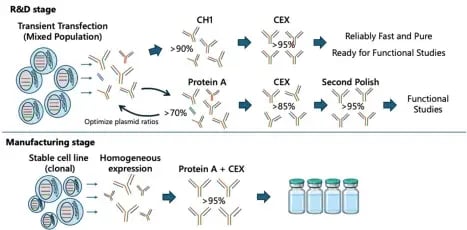
- For early work, Invenra adjusts DNA ratios and purifies with anti-CH1 resin, which captures the correctly assembled B-Body. It reaches over 95% purity in two steps and supports hundreds of bispecifics a month.
- Once a program moves to stable cell lines, correct assembly routinely exceeds 85%, and a standard Protein A plus cation exchange process delivers therapeutic-quality material at lower cost.
Anti-CH1–based purification, combined with an optimized DNA ratio, is the most efficient and cost-effective approach for early, transient expression of B-Body multispecific antibodies, while Protein A is better reserved for later, stable cell line–based manufacturing.
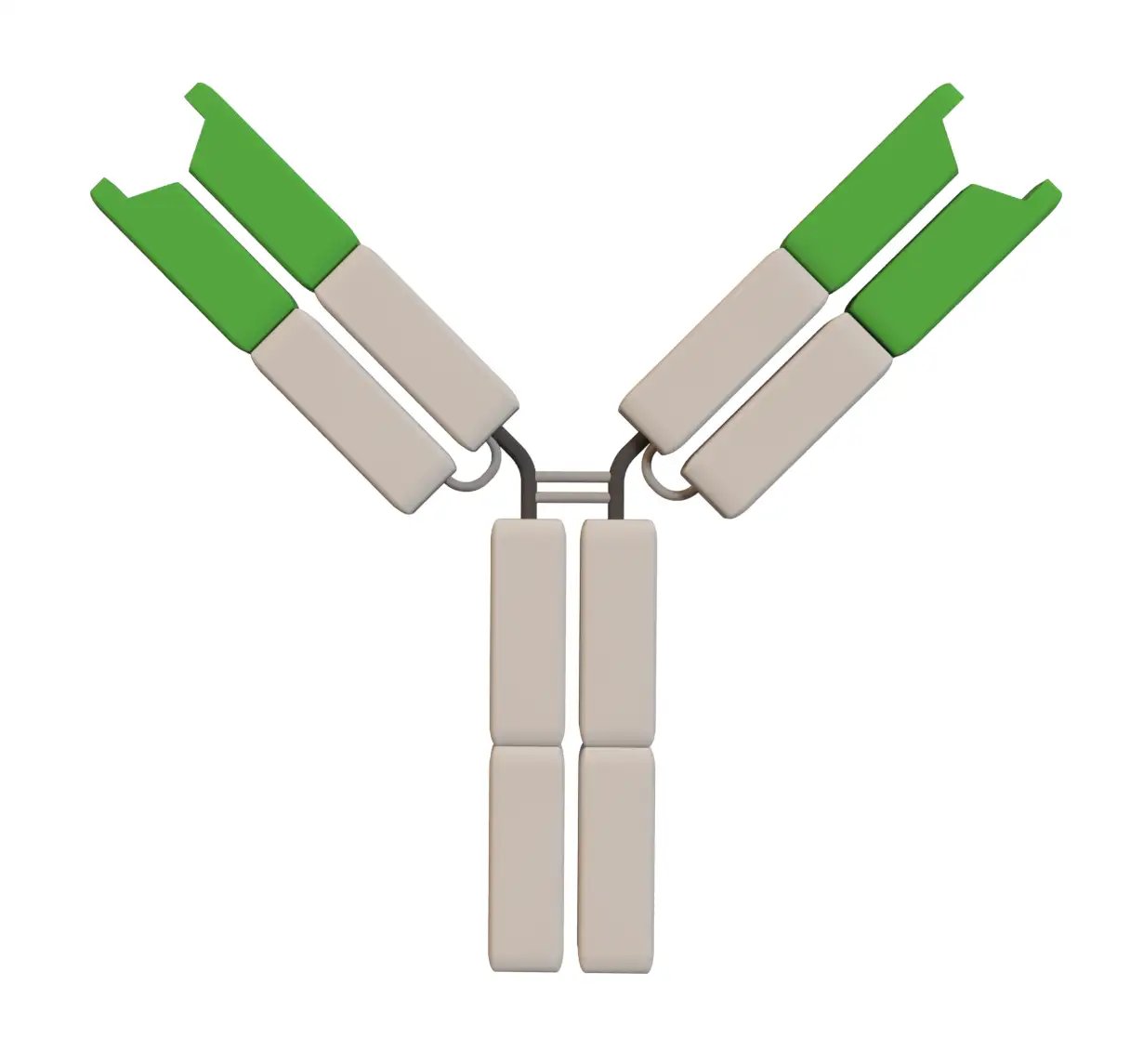
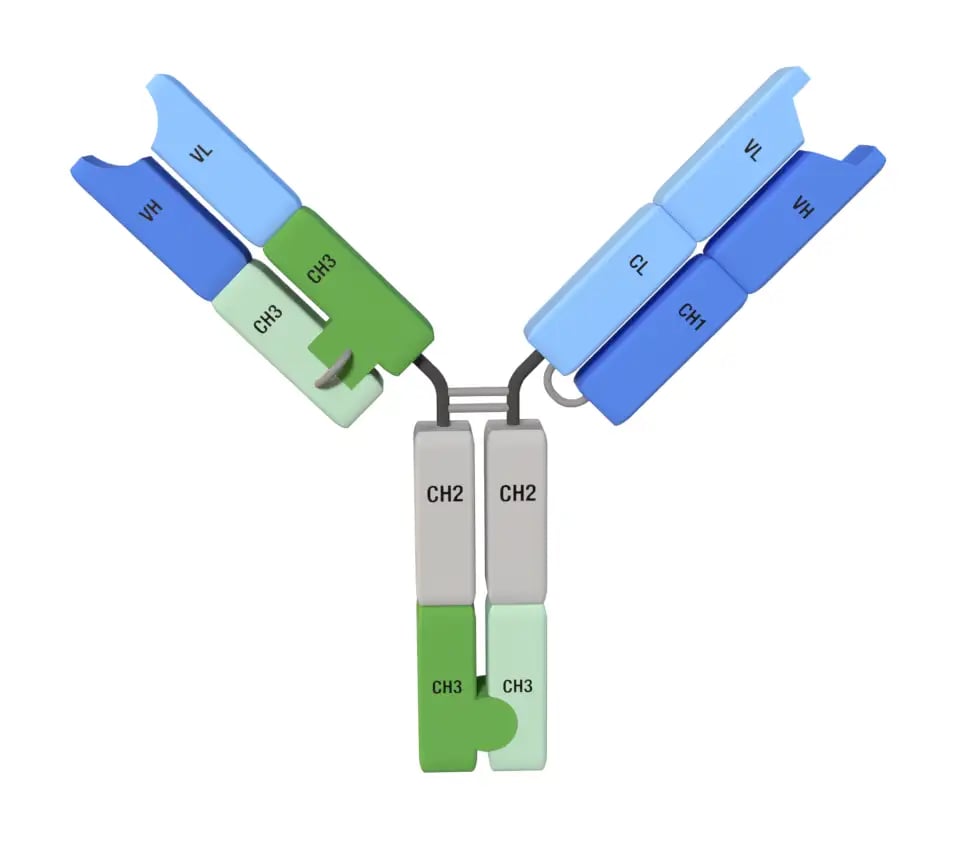
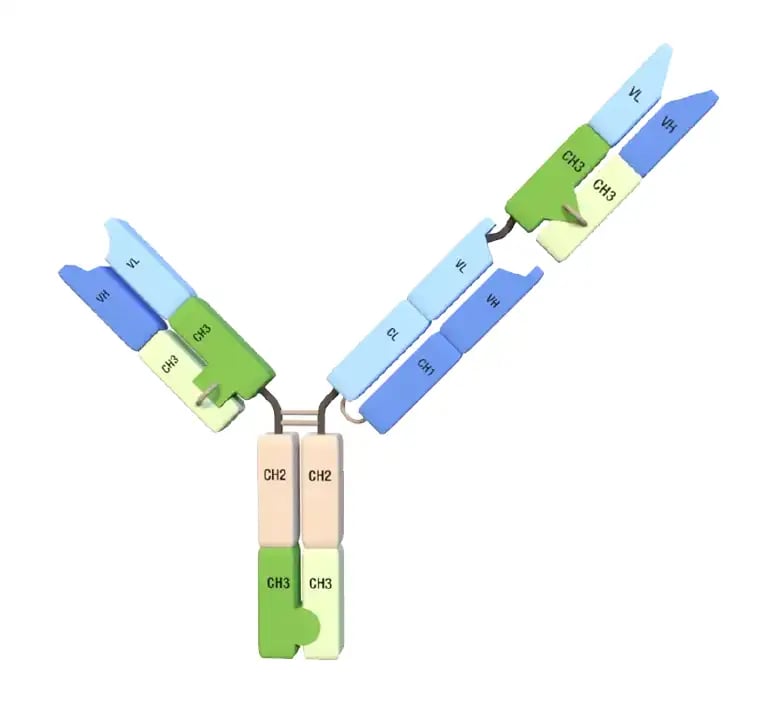
Multispecific antibodies are precision-engineered proteins requiring correct pairing of four or more distinct peptide chains.
Unlike a standard monoclonal antibody, which pairs two identical heavy chains with two identical light chains, a multispecific must pair the right chains. Any single chain over- or under-expressed leads to aberrant homodimers or incomplete constructs.
Protein A complicates early POC work
During discovery and proof-of-concept stages, most programs rely on transient transfection, introducing plasmid DNA directly into a pool of CHO cells for rapid expression.
Each cell randomly takes up the four plasmids, so while the pool on average expresses balanced amounts of each chain, individual cells are not optimized.
During purification, Protein A captures both correctly and incorrectly assembled antibodies through conserved Fc and Fab regions leading to a higher fraction of misassembled protein, requiring additional purification steps and project-specific optimization of DNA chain ratios.
Anti-CH1 improves purification efficiency
For optimized transient expression, Invenra uses a two-part strategy:
-
Adjust input DNA ratios to push average chain expression toward a specific balance.
-
Purify using an anti-CH1 resin, which, in the B-Body platform, captures a specific assembled product rather than binding everything with an Fc domain.
This approach sidesteps the costly project-specific scouting work required by Protein A purification at the transient stage.
Anti-CH1 purification enables high-throughput production of hundreds of bispecifics per month at suitable purity and yield for preclinical assays. It's also automation-friendly and scalable across many projects, saving both time and money.
Cost, time, scalability, and stage-appropriate tools
Anti-CH1 purification is the right strategy for rapid, cost-effective screening of B-Body multispecific antibodies during early development. The process delivers >95% purity after a 2-step process.
Once a program advances into cell line development and stable clones are selected, it naturally transitions to the lower-cost, platform-compatible Protein A approach. When used in a manufacturing environment with stable, balanced cell lines, correct assembly routinely exceeds 85%, enabling a standard two-step Protein A + CEX purification to yield therapeutic quality material.
We hope this clarifies the trade-offs so you can select the expression and purification workflow that best fits where your program is today.
Talk to us
Moving a bispecific from proof of concept toward cell line development? Tell us your format and where the program is today, and we'll walk you through the expression and purification workflow that fits this stage and the next one.
Contact us »
Have sequences already? We'll express and purify them as B-Body bispecifics using the anti-CH1 workflow described above. See B-Body Expression »