The following is a lightly edited transcript from the micro-summit video below.
Get the slides: 12x12 Matrix Screening with B-Body® and T-Body Platforms (PDF) »
Most antibody-drug conjugates (ADCs) target one antigen. Real tumors are rarely that uniform, and breast cancer is a good illustration: HER2-high, HER2-low, and triple-negative disease behave differently, and an ADC that works against one may do nothing against the others.
The question I answer here is what happens when you stop guessing which target pair to build and instead build all of them.
You can scroll through the full data deck here (PDF).
The multispecific antibody platform
Hello, I'm Bonnie Hammer, and I lead R&D for Invenra. Today I'm going to tell you about Invenra's B-Body® and T-Body™ platforms, and show you the power of rapid prototyping with multispecific antibodies for ADCs.
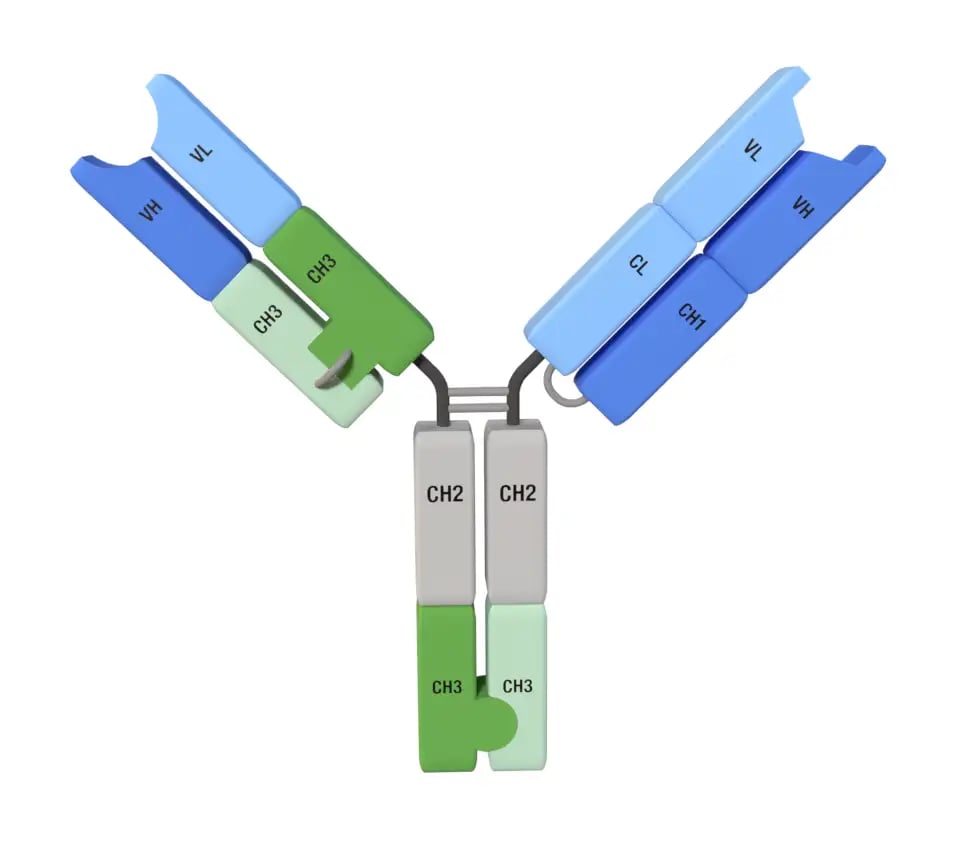
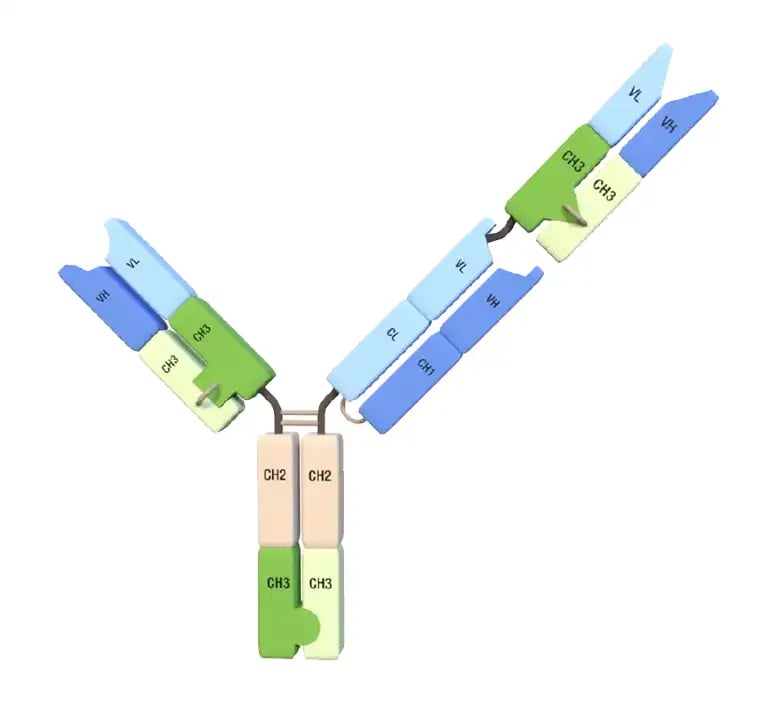
Here I'm showing a schematic diagram of the B-Body bispecific and T-Body trispecific platforms.
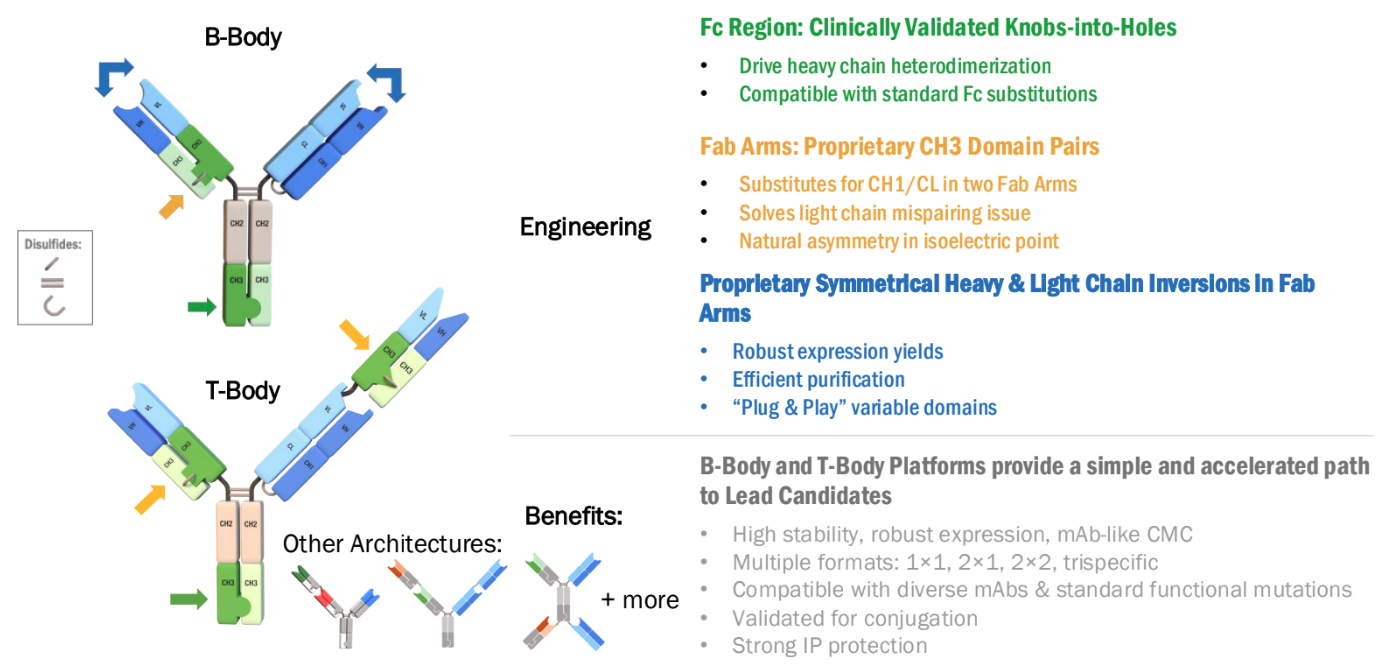
As you can see, they are IgG-like platforms where we have swapped out one or two of the CH1 domains with proprietary CH3 domains for very robust heavy and light chain pairing.
Importantly, the platform is amenable to high-throughput expression in 96-well plates with a single-step purification.
Building a 12×12 matrix
We used the B-Body bispecific platform to express a 12×12 matrix of bispecific antibodies, where we took six different antigens and two different antibodies to each target antigen.
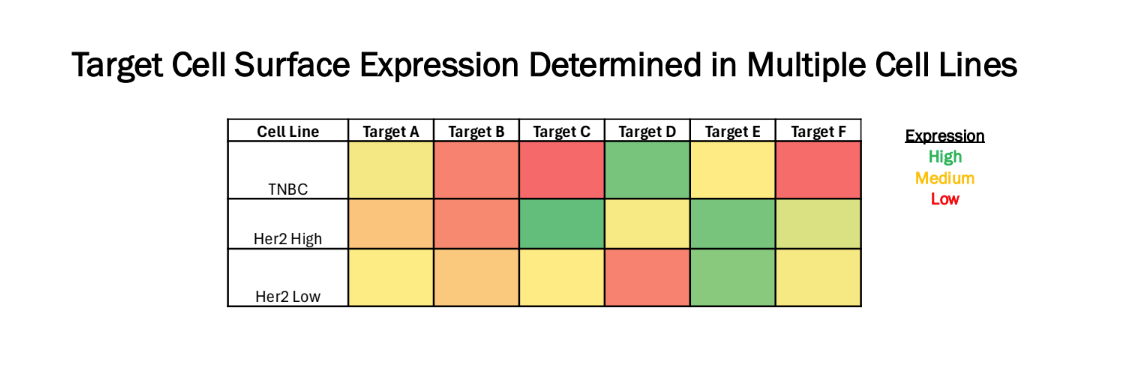
Multiple breast cancer cell lines used in a 12x12 B-Body bispecific matrix screen. Selected cell lines show diverse phenotypes and expression of targets.
The antigens showed a diverse expression profile across a triple-negative breast cancer cell line, a HER2-high cell line, and a HER2-low cell line.
Screening across three breast cancer models
We then screened the 12×12 matrix across the three cell lines using a piggyback ADC assay with MMAE toxin. This is a heatmap snapshot of cytotoxicity across those cell lines at 4 nM antibody.
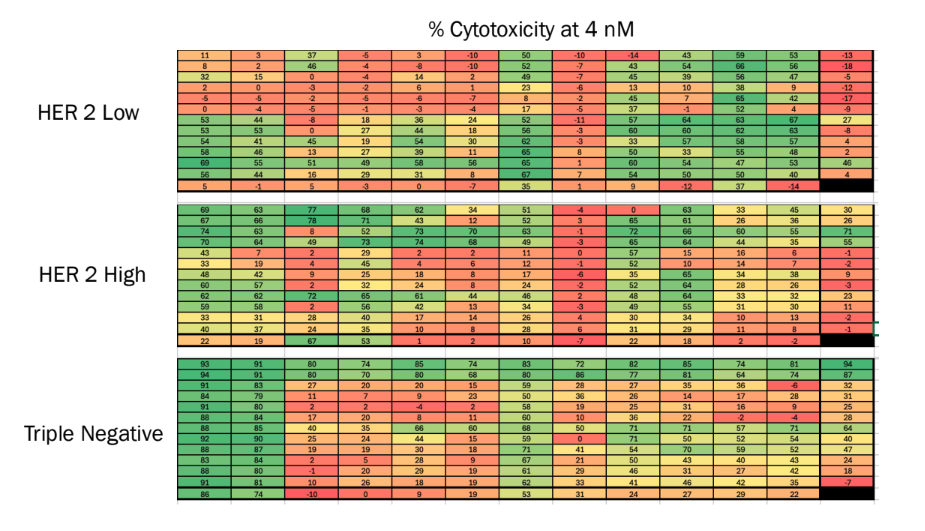
Heat maps of cytotoxicity across three distinct breast cancer cell lines for a B-Body bispecific matrix in Piggyback ADC (MMAE).
Reading the data in three dimensions
Now, representing that data slightly differently, we made a plot where the cytotoxicity is represented in three dimensions: the HER2-low cell line on the y-axis, the HER2-high cell line on the x-axis, and the color of the data point for the triple-negative breast cancer.
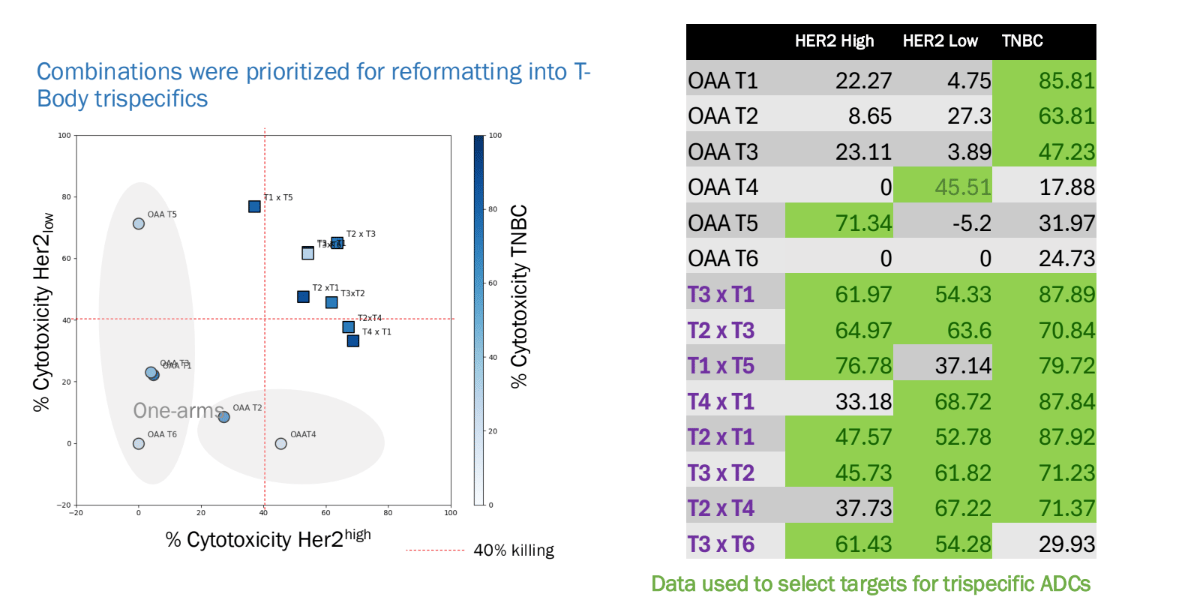
You can see that the one-armed antibodies (OAA) only kill one cell line well. Meanwhile, the top bispecific combinations kill two or three of the cell lines well.
From bispecifics to trispecifics
We took the information from this bispecific screen, and we made a set of trispecific molecules.
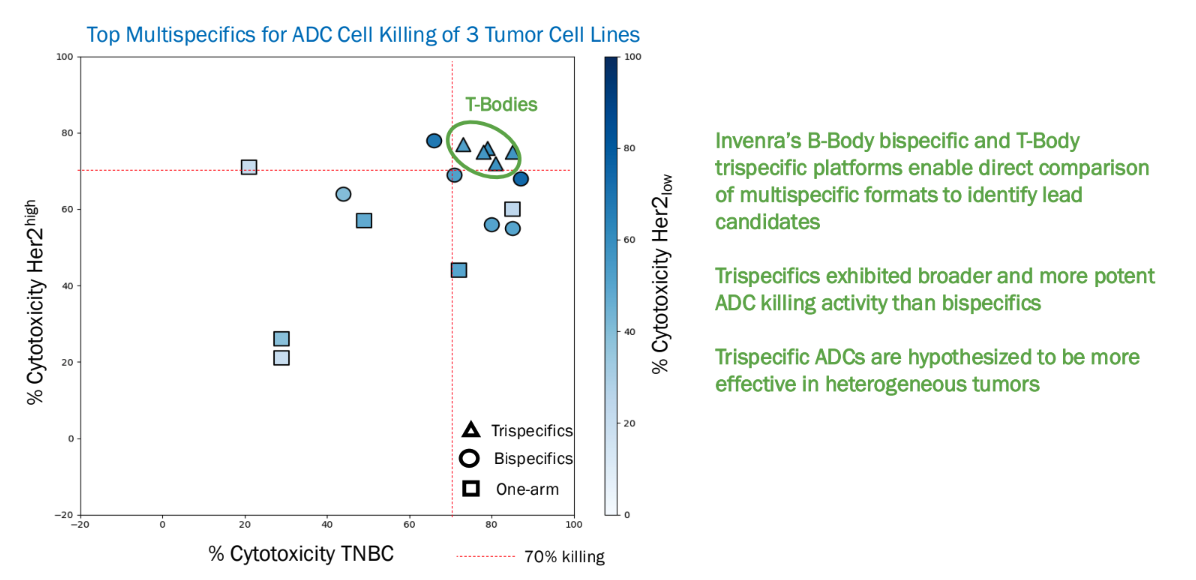
This is now the data from the trispecifics, where we see that the trispecifics, indicated in triangles, are localizing in the upper right-hand corner and killing all three cell lines well. Followed by the bispecifics in circles and the one-armed antibodies in squares.
Hopefully I've given you a taste of the power and the robustness of Invenra's B-Body and T-Body platforms for making large matrices of molecules, which allow for rapid prototyping of multispecifics for ADCs, to pick the best combinations for particular indications.
Thank you!

Three things worth taking from the data here:
Valency tracked with breadth. One-armed antibodies performed well against a single line. Bispecifics reached two or three. Trispecifics clustered in the high-killing region across all three. The pattern emerged from a matrix rather than appearing in one flattering pair.
The bispecific screen was the input, not the answer. The trispecifics were not designed on a hypothesis alone. They were built from target pairs that the 12×12 screen had already ranked as top performers, which is a different way of arriving at a three-armed molecule than reasoning toward one.
Scale made it possible. Screening a 144-member bispecific matrix against three cell lines is only practical if the molecules express in 96-well plates and purify in a single step. That is a platform property, not a screening choice, and it is what makes matrix-based prototyping realistic rather than aspirational.
Talk to us
Tell us what you're building, what stage you're at, and what terms matter to you. We'll give you a straight read on whether we're the right fit, including when we're not.
Contact us »
Or start with the data: 12x12 Matrix Screening with B-Body® and T-Body Platforms (PDF) »
 White paper
The Plug-and-Play Advantage of Invenra’s Multispecific Platforms
Invenra’s B-Body® and T-Body™ modular multispecific antibody platforms enable plug-and-play assembly and format-agnostic purification to deliver consistently high-purity bispecific and trispecific antibodies.