Antibody-Drug Conjugate (ADC) Discovery Bispecific and trispecific ADCs built and screened

Most ADCs use one antibody against one antigen. ADCs can require additional mechanisms of action to optimize tumor response. We discover bispecific and trispecific antibodies on our IgG-like B-Body® and T-Body™ platforms, screen them for tumor killing in ADC assays, and hand you a lead built for conjugation. Collaborate with us as your ADC partner.

8.8

Day half-life in hFcRn Tg32 mouse PK study

0

ADC design mechanisms, from biparatopic binding to conditional activation

>0×

Internalization with biparatopic binding

0

Breast cancer subtypes currently targeted by a single T-Body trispecific

WHY MULTISPECIFIC ADCS One antigen is rarely enough for challenging tumors

A single-target ADC can bind well and still fall short because the problems that limit ADCs are linked with tumor complexity. Adding a second or third can address this directly.

The Invenra multispecific antibody platforms offer elegant solutions to some of the toughest problems in ADC discovery:

  • Antigen heterogeneity and escape: One target misses the cells that don’t express it, and tumors can downregulate it under treatment pressure.
  • Poor internalization: Binding isn’t enough. The payload has to get inside the cell.
  • Off-tumor toxicity: Many good ADC targets also appear in healthy tissue.
Multispecific Answers
Target multiple antigens to reach more of the tumor.
Two epitopes on one target drive the clustering that pulls it into the cell.
Logic gating and conditional activation confine activity to the tumor.

INVENRA’S ADC DESIGN STRATEGIES Four ways a third arm boosts an ADC

Our trispecific ADC work is organized around four mechanisms. Each addresses a different ADC challenge, and each can be screened against its bispecific equivalent to confirm the third arm (trispecific) is worth pursuing.

inv-icon-levers
Biparatopic Plus

Two arms bind different epitopes on the same target, driving the receptor clustering that enhances internalization. The third arm adds breadth or blocks a route of resistance.

Example: HER2 × HER2 × HER3

inv-icon-path
Three-antigen targeting

Three tumor antigens on one molecule, so a heterogeneous tumor has fewer places to hide.

Example: Nectin-4 × EGFR × B7-H3

inv-icon-logic
HYPER-Internalization™

Deliberately weak tumor-antigen arms only cluster into strong binding where VEGF is abundant, in the tumor microenvironment. It lets you use targets that are too broadly expressed to hit at full affinity. Strong in vitro data; in vivo confirmation is the open question.

Example: EGFR × VEGF × HER3

inv-icon-secure
Stromal plus tumor (early stage)

Reach both the tumor and the supporting stroma around it. Our earliest-stage mechanism, likely paired with a dual-payload strategy.

Example: cMET × B7-H3 × LRRC15

THE ANTIBODY PLATFORM Built to carry a powerful payload

Fragment formats such as scFvs and VHHs tend to be more hydrophobic, and that liability compounds as the architecture gets more complex and a hydrophobic payload is attached. Our B-Body® and T-Body™ platforms are built entirely from Fabs, the stable building blocks nature uses in the human body, so the molecule starts from a stronger foundation.
t-body-features2-white-wide
  • Compatible with standard conjugation strategies
    ADC compatibility has been validated by a third party. Cysteine conjugation on T-Body has reached DAR 6.
  • Expresses like a mAb
    T-Body™ trispecifics have expressed up to 1.5 g/L in transient expression and have been concentrated up to 100 mg/mL.
  • IgG-like pharmacokinetics

    T-Body™ trispecifics have shown a 6.6-day half-life in rats and 8.8 day half-life hFcRn Tg32 mice.

  • Standard CMC
    Protein A and ion exchange polishing.
  • No common light chain
    Kappa and lambda light chains, standard Fc modifications, and binders from any source.
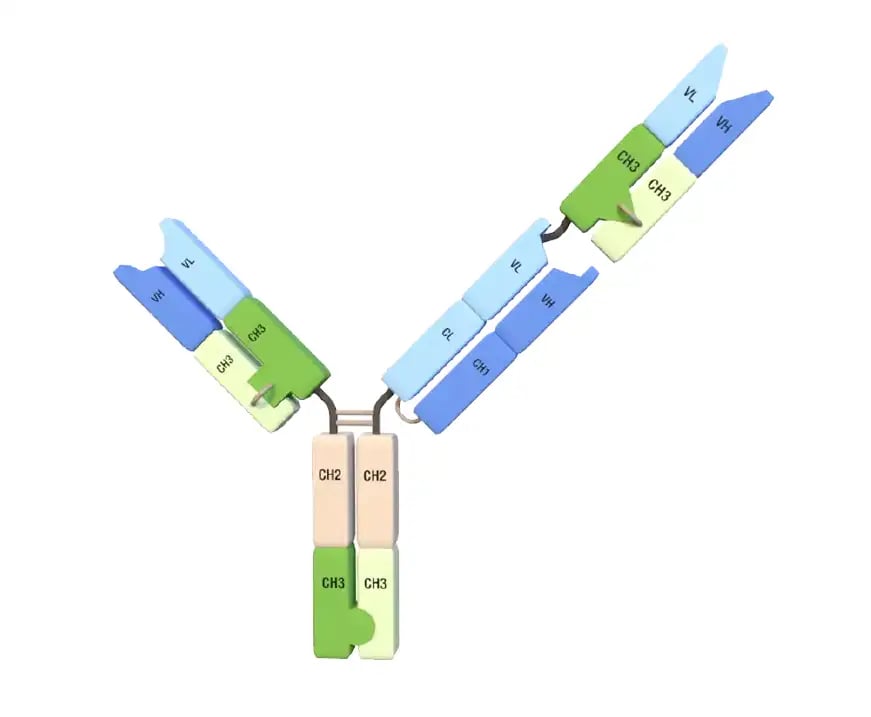
  • The T-Body™ trispecific scaffold
    Three Fab arms on one IgG-like antibody, with engineered constant domains that direct correct chain pairing.

Platform in Action A triple-threat ADC for heterogeneous breast cancer

Breast cancer isn't one disease. We set out to find a single molecule that targets three distinct tumor profiles: HER2-high, HER2-low, and triple-negative.

The approach

A 12×12 bispecific matrix, screened for ADC killing

  • Included both biparatopics and one-armed controls
  • Screened every molecule for ADC killing across 3 tumor cell lines
  • Measured killing with a piggyback ADC assay (MMAE toxin), scored from plate data alongside developability
  • Built and tested the best pairs as T-Body trispecifics
Why the T-Body™ platform makes this possible

The B-Body® platform screens a large number of molecules, then moves the winners straight into the T-Body™ trispecific format

  • Plug-and-play variable domain design
  • Hundreds of bispecifics screened in parallel, in a single matrix
  • Designed so the best bispecific pairs can be seamlessly rebuilt as trispecifics.

  • Killing and developability scored together, from the same plate data

The results

Screening the bispecifics first shows which target pairs work, and comparing B-Body bispecific and T-Body trispecific formats head-to-head identifies the lead candidates.

Details
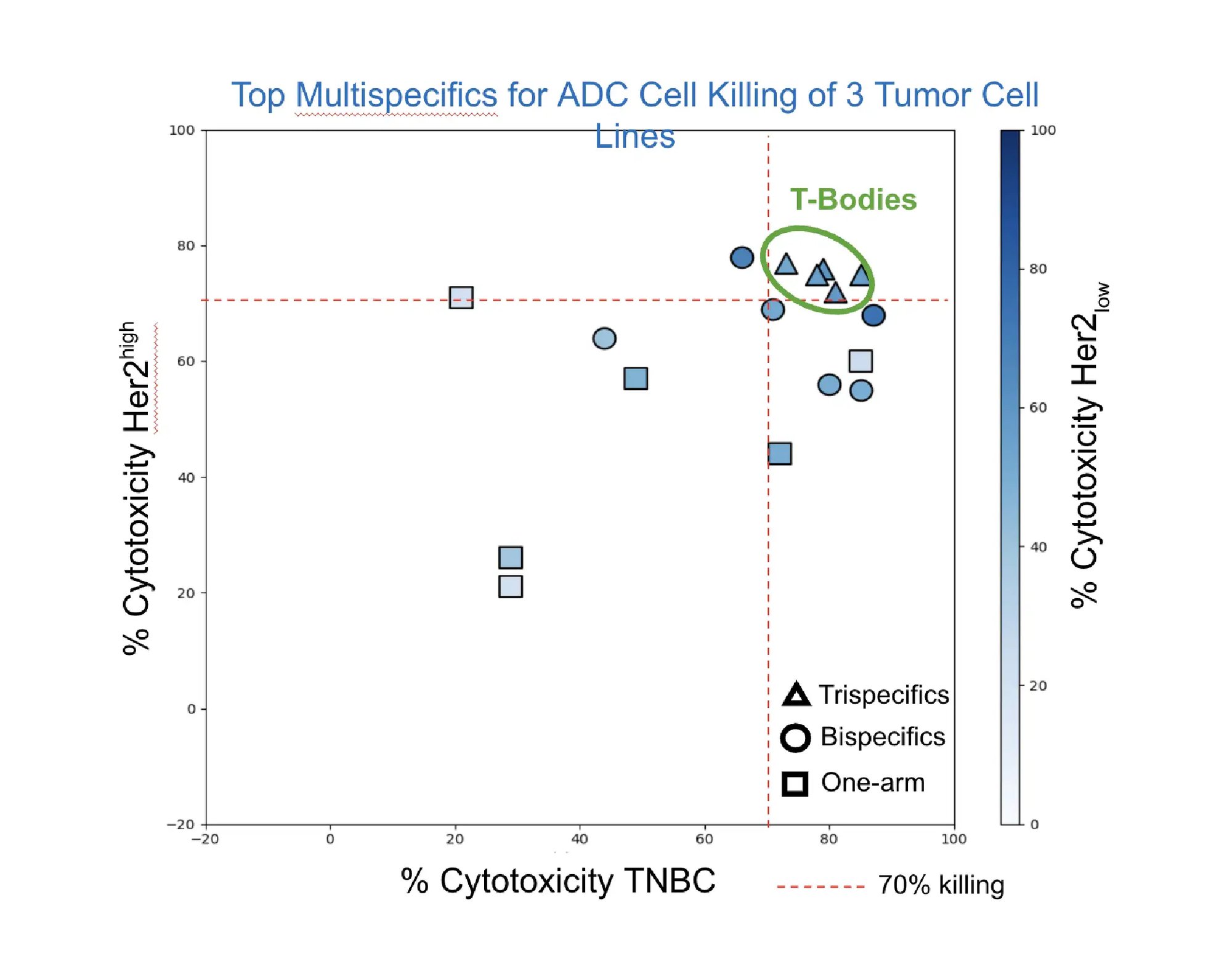
  • Trispecifics clustered in the high-killing zone, past the 70% gates, ahead of the bispecifics and one-armed controls

  • Trispecifics showed broader and more potent ADC killing than the bispecifics

  • Trispecific ADCs are expected to work better in heterogeneous tumors

Screen hundreds of bispecifics first
inv-TBodyDiscoveryGraphics-38

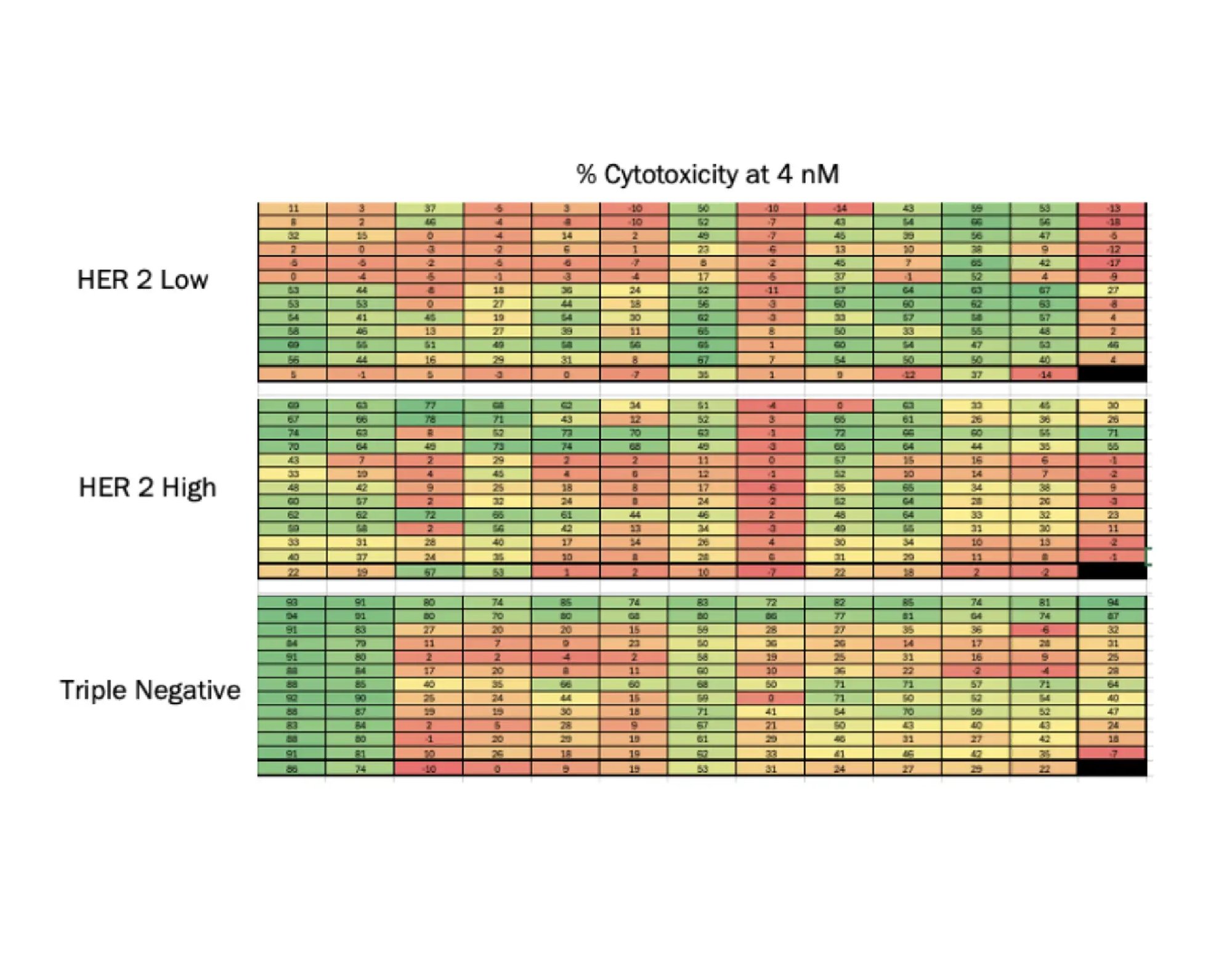
Per-cell-line killing at 4 nM for hundreds of bispecifics across Her2-low, Her2-high, and triple-negative lines. This screen finds the best bispecific target pairs, which then inform which trispecifics to build.

Then let the activity pick the winners
inv-TBodyDiscoveryGraphics-40-1
Formats compared head-to-head

Trispecifics (triangles, circled in green) cluster in the high-killing zone, past the 70% gates — ahead of bispecifics (circles) and one-armed controls (squares).

  • Comparing B-Body bispecific and T-Body trispecific formats head-to-head identifies the lead candidates.
  • Trispecifics showed broader and more potent ADC killing than the bispecifics.
  • Trispecific ADCs are expected to work better in heterogeneous tumors.

How it works From targets to ADC-ready leads

Every program is scoped to your target product profile.

Co-design the target product profile

Targets, format, valency, and what the ADC has to do, agreed with your team before any lab work.

Source the binders

From our mAb Discovery engine, from your own programs, or from the public domain.

Build the matrix in the final format

Bispecific combinations are expressed and then purified in a single step.

Screen for ADC killing

Piggyback ADC assays across disease-relevant cell lines, with developability scored alongside.

Rebuild the best pairs as trispecifics

When the biology calls for a third arm, winning pairs move into T-Body™ platform.

Select the lead together and hand off

A consultative data review, then the full data package for a lead built for your conjugation chemistry.

Optional add-ons Get deeper characterization

Most programs add structured characterization beyond what’s included in the matrix screening: biophysical, binding kinetics, and formulation. We run all of it in-house. You don’t need another outsourced partner or potential in-house lab delays.
inv-BindingSuite-02

BIO

Full biophysical + binding suite

Carterra LSA high-throughput binding kinetics and epitope diversity, validated cell binding analysis, in silico liability scanning, mass spec for intact mass confirmation, full developability assay panel, and high-concentration formulation optimization.
devreport-card

DEV

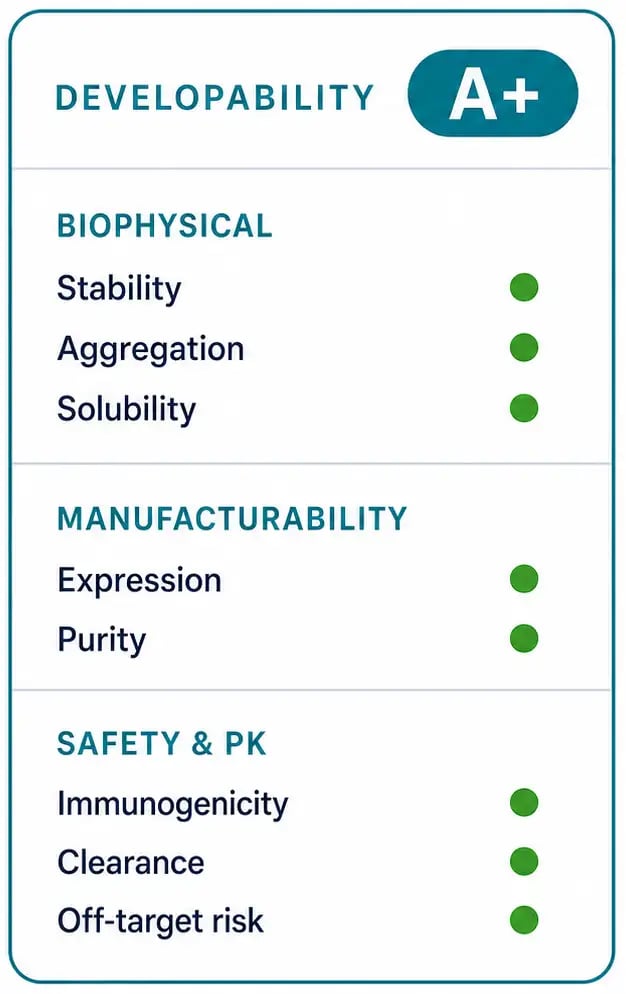
Extensive developability capabilities

Expression and purity, thermal stability, self-association, aggregation, solubility, immunogenicity risk, viscosity, each measured with a validated technique. The full developability data sits behind every lead candidate we hand off.

HOW TO PARTNER WITH US Three ways into an ADC program

Bispecific ADC work follows the staged structure of B-Body® Discovery, with standard pricing. Trispecific ADC programs are scoped as partnerships around your target product profile, with pricing, terms, and licensing established during planning before any commitment. Flexible licensing models can include evaluation options, milestone-based terms, tiered royalties, and sublicensing arrangements.

Run an ADC discovery program

You bring the targets and the biological hypothesis. We handle binder discovery, bispecific and trispecific assembly, ADC screening, and characterization.

Bring your antibodies

Already have binders you believe in? We build them into bispecific or trispecific formats and screen them for ADC killing.

License a program from us

Interested in licensing a trispecific program? Reach out to us!

HeartsA_2497853616775108489_5284364185457893928

52 views of cancer

First in class trispecific ADC molecules

Our 52 Views project goes beyond developing trispecific ADCs and making these novel therapeutics available to partners. We are creating a one-of-a-kind playing card deck that celebrates the creativity, resilience, and spirit of people whose lives have been touched by cancer.

Each of the 52 cards features original artwork from a cancer patient, survivor, or immediate family member, making every card a unique view of the human experience with this disease.

Hammer-Cropped-copy
Bonnie Hammer Executive Vice President, Research & Development, Invenra

The preclinical data demonstrate the amazing potential of trispecific ADCs. Invenra is exploring how trispecific targeting can improve payload delivery and address signaling pathways that may contribute to treatment resistance."

Frequently Asked Questions Quick answers to initial questions

Does Invenra conjugate the ADC?

We discover and engineer the antibody and screen it in ADC-relevant killing assays. The platforms are compatible with standard conjugation strategies, so the lead you receive is built to carry your chosen payload. Tell us about your conjugation plans and we’ll talk through what fits your program.

Which conjugation chemistries work with your platforms?

Standard conjugation strategies are compatible.

Should my ADC be bispecific or trispecific?

We don’t decide in advance. We screen bispecific and trispecific configurations side by side and let the killing and developability data decide.

Can you use antibodies we already have?

Yes. Binders from your own programs, your previous partner, or the public domain can go straight into the matrix. No common light chain is required.

What is 52 Views of Cancer?

52 Views of Cancer is an Invenra initiative featuring a playing card deck with original artwork from cancer patients, survivors, and family members. By bringing their artwork and stories into scientific spaces, the project connects the human side of cancer with Invenra’s efforts to develop next-generation antibody-drug conjugates (ADCs) and advance cancer treatment.

Where is the work actually done?

At our labs in Madison, Wisconsin. Discovery, expression, and characterization all run in-house.

What are the licensing terms?

They’re set program by program. Bispecific discovery has no milestones or royalties on the resulting molecules. Trispecific partnerships can use evaluation, milestone, royalty, or sublicensing structures. Reach out and we’ll talk through your program.

Get in touch Let’s talk about your ADC program

Tell us about your ADC program, wherever it is right now. We will get back to you to start the conversation, typically within one business day.

Your information is 100% confidential.

We don't share your data with third parties, add you to marketing lists without permission, or contact you about anything other than this request. Target biology is treated as confidential. Need an NDA first? Just say so. We'll send one over.