Invenra's approach to discovery

We take you from target to lead candidate

You bring the targets and the biology. We find the antibodies, build the molecules, test them in their final format, and let the data guide your lead choice. Here is the whole workflow, from a monoclonal through to a trispecific.

The core idea Let the biology win

Most drug discovery in our space asks you to compromise early. Simplify the molecule, narrow the design space, commit to a lead before the data is in. We run it the other way around: widen the design space, build the real molecules, test them in their final format, and let biological function decide which one moves forward.

Our platforms and processes  exist to make that possible. An antibody design that lets you keep your binders and a real IgG, and a process built to test many candidates at once instead of betting on a few.

©mh-Invenra-0007-crop

Solving the problem

Creating multispecific antibodies is hard

A monoclonal antibody has two identical arms, so its heavy and light chains pair correctly on their own. A multispecific has different arms, so the chains can pair the wrong way, and every arm you add multiplies the number of potential problem combinations. Get it wrong and you make a mess of mispaired, non-functional molecules. With trispecifics, the complexity increases sharply.

Most platforms get around this by giving up the natural antibody shape (fusing fragments or building unnatural scaffolds) or forcing every arm onto a shared light chain. Both work, and both cost you something. The first gives up a real antibody’s half-life and manufacturability. The second limits can limit which binders you are allowed to use.

Designing the solution The fix lives in the constant domains

We put the engineering where it doesn’t impact the biology. The changes happen in the constant domains, the structural scaffold, so the right chains pair on their own, maintaining an IgG-like structure. The binding regions — the pieces that recognize your target — are left alone.

We will use the B-Body platform as an example.  A similar approach applies when using the T-Body platform, allowing for a direct funtional comparison

. Our unique design enables three benefits. You can use the binders you want. You keep a real antibody with its half-life, manufacturability, and familiar CMC. We took what we learned from our bispecific engineering approach and enhanced it, allowing direct comparison between B-Body bispecifics and T-Body trispecifics.

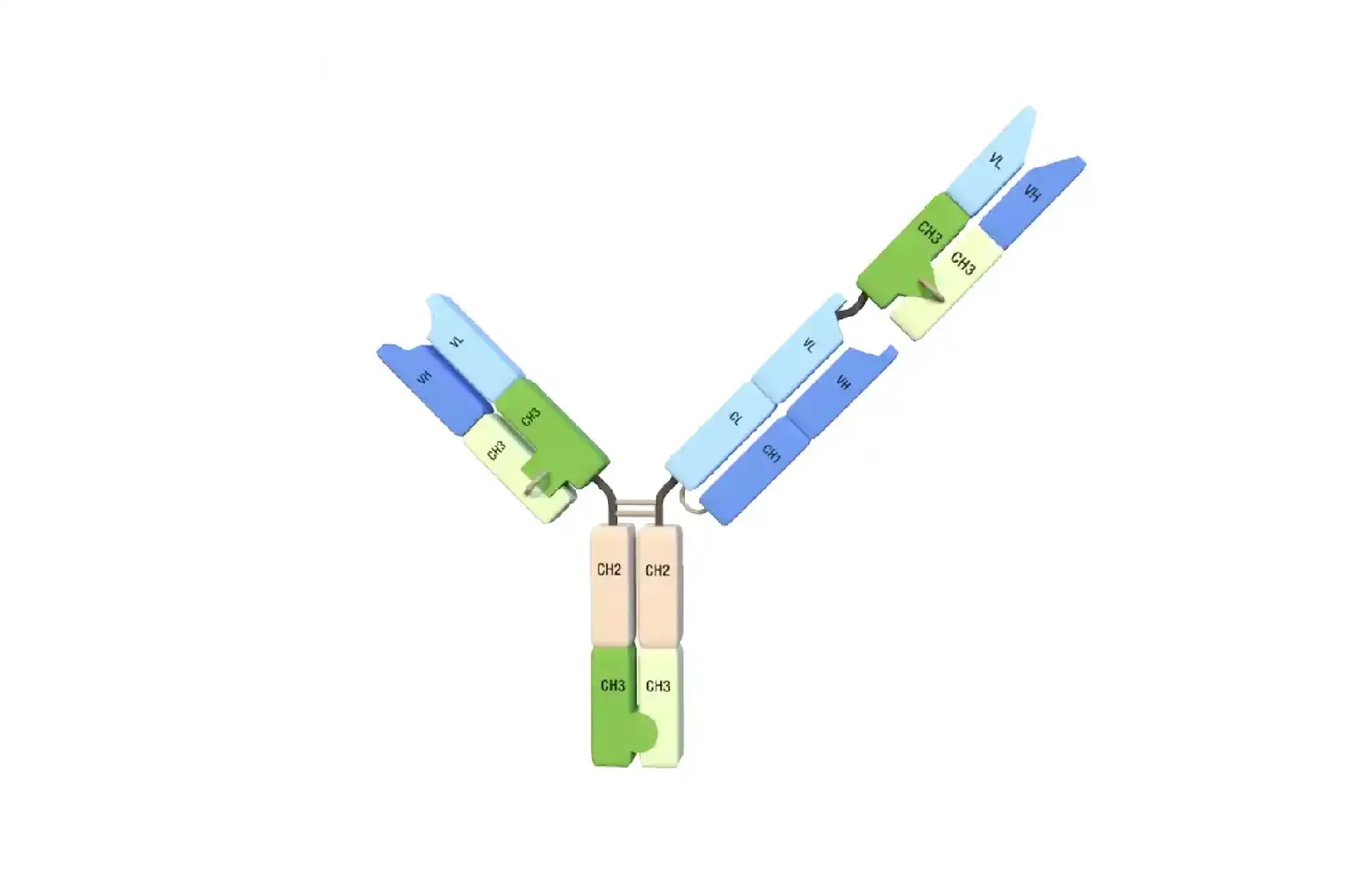
B-Body bispecific antibody

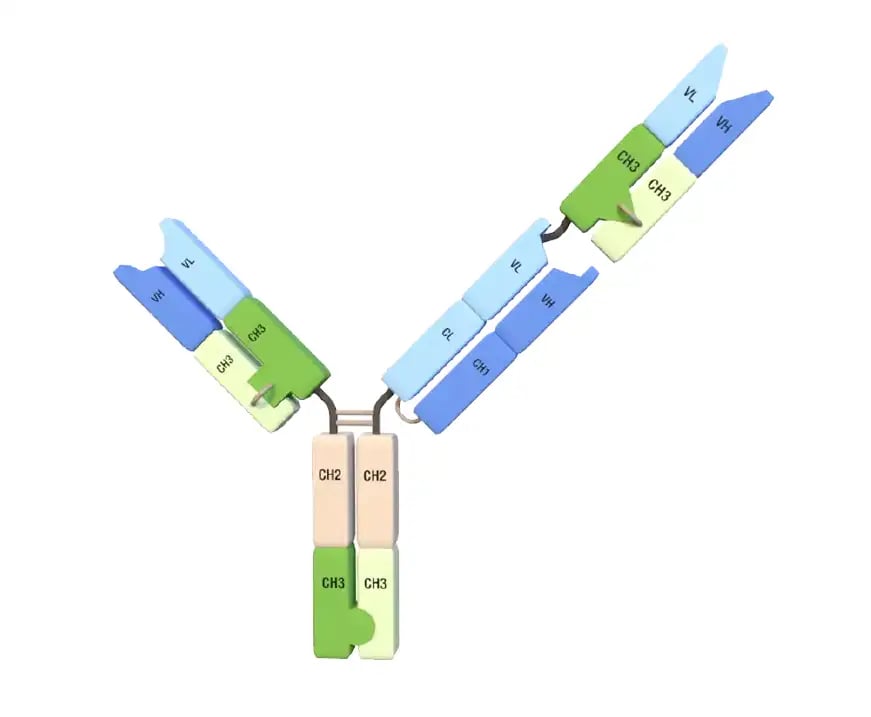
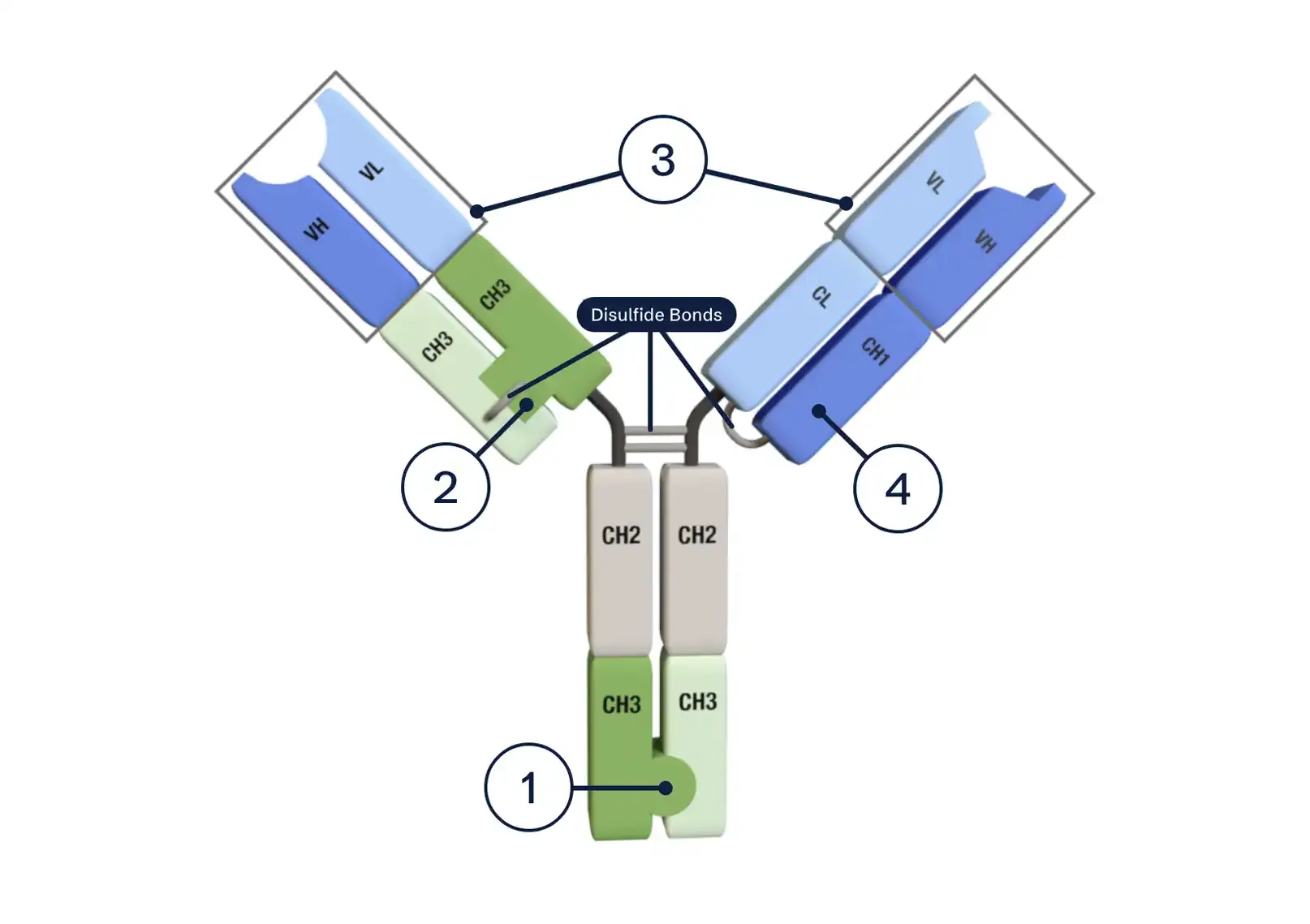
The B-Body platform, with the four engineering changes numbered

inv-BBodyDiscovery-wide-01
  • 1. Knobs-into-holes Fc
    One heavy chain gets a “knob,” the other a “hole,” so they pair with each other instead of themselves.
  • 2. Proprietary CH3 domain pairs
    These replace CH1/CL in a Fab arm, so the correct light chain pairs on its own. No common light chain needed.
  • 3. Plug-and-play variable domains
    Bring binders from any source. The binding regions aren’t re-engineered, so what you put in is what you test.
  • 4. Sole CH1 domain
    One arm keeps a CH1, so a single anti-CH1 step pulls out the correctly assembled molecule, leaving the rest behind.
T-Body bispecific antibody

T-Body expands on the proven architectural principles used in our B-Body bispecific platform by enabling a third specific Fab

t-body-features2-white-wide
  • 1. Proprietary CH3 domain pairs
    Replace CH1/CL in two of the three Fab arms with two uniquely configured CH3 domain pairs. Solve light-chain mispairing for clean, straightforward purification.
  • 2. Symmetrical chain inversions
    Proprietary heavy- and light-chain arrangements in the Fab arms deliver robust expression and efficient purification.
  • 3. Knobs-into-holes Fc
    Clinically validated heavy chain heterodimerization. Compatible with standard Fc substitutions for effector function engineering.
  • 4. Validated binding kinetics
    BLI and SPR confirm simultaneous 3-antigen engagement. Each arm’s kinetics is independently assessed. Comparable performance between trispecifics and one-armed controls.
  • 5. Custom trispecific formats
    The platform flexibility allows nearly endless orientations, valencies, and formats.

The workflow Test the real molecules, then let the data choose

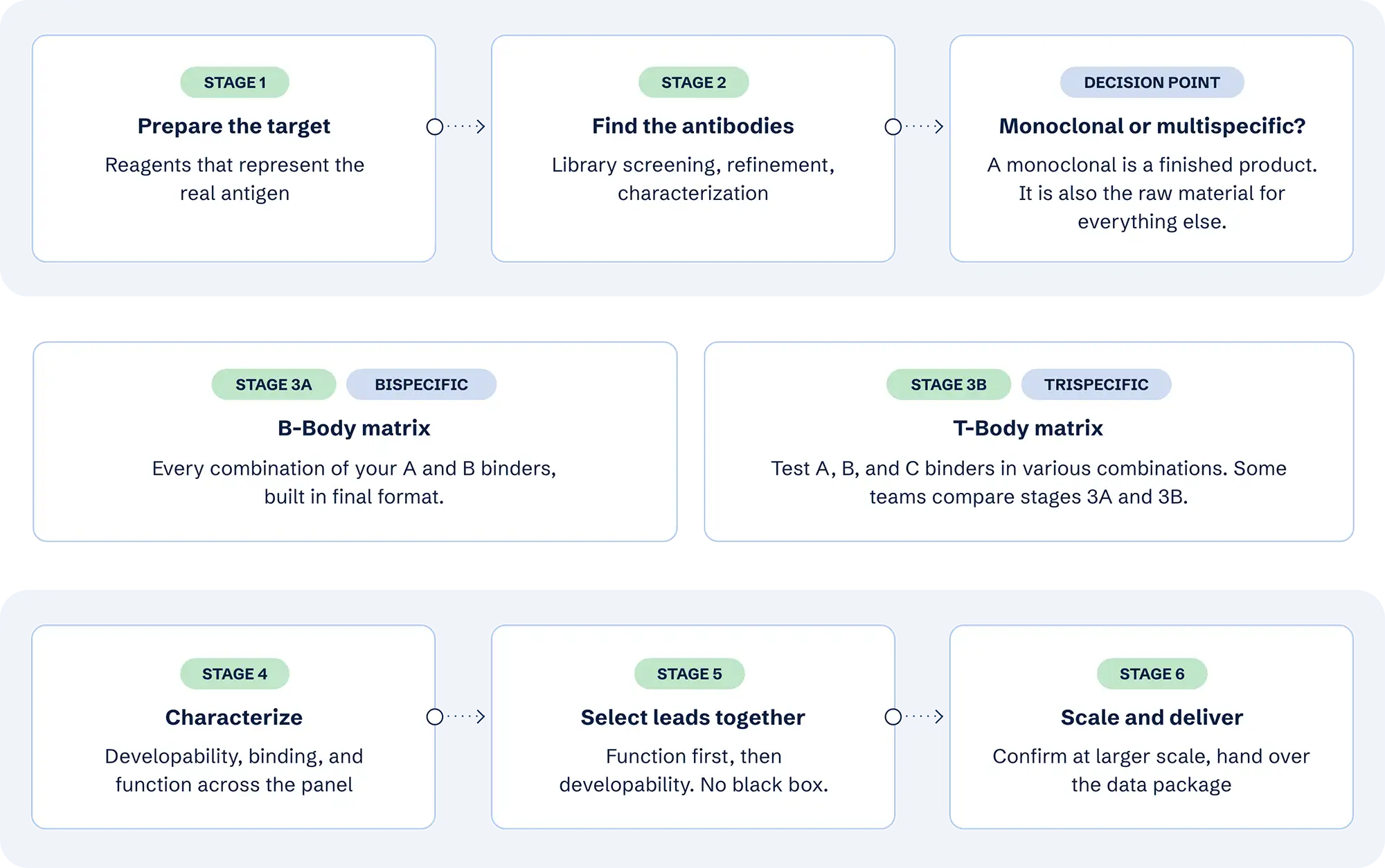
Monoclonal, bispecific, and trispecific programs share the same front half. You find good antibodies first, then decide what to build with them. The workflow branches at the point where molecules get assembled.

Because the molecule assembles like a real human antibody, we don’t screen a stand-in and reformat the winner later. The actual final-format molecules are built and tested from the start in parallel across a matrix. The data you evaluate is the data that carries forward.

inv-Graphic-HowItWorks-06
Where you start

You bring the targets

We run the full workflow, starting from library screening. This is the path if you don't have binders yet, or if you want the design space explored properly rather than working from the few antibodies already available.

You bring the sequences

If you already have antibodies, your sequences go straight into the matrix. Because we don’t require a common light chain, the antibody you bring is the antibody we build with.

AET-20251214-Enabling-Rapid-Bispecific-Antibody-Discovery-with-Invenras-B-Body-Platform-copy
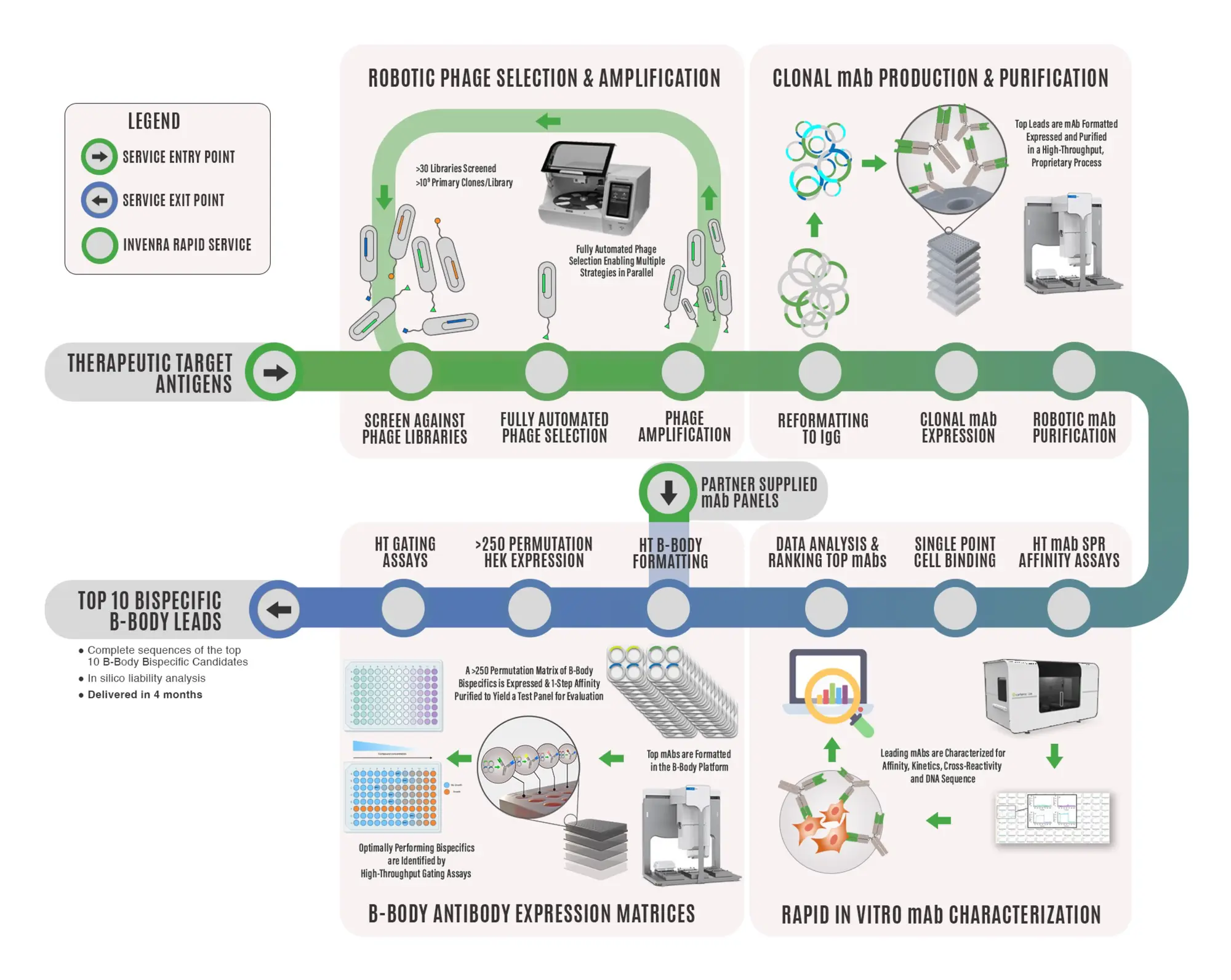
The full discovery workflow end-to-end.

The green track is monoclonal discovery and characterization. The blue track is multispecific assembly and screening. Partner-supplied antibody panels enter at the marked point.

Stages 1 and 2 Finding the antibodies

If you are starting with targets rather than sequences you have already identified. We start our antibody discovery engine. This is the front half of the workflow, and it’s the same whether you end up with a monoclonal, a bispecific, or a trispecific.

inv-affinity
Prepare the target

Before anything gets screened, the target must exist in a form worth screening against: cell lines or purified protein presenting the antigen as it appears in the body. Where you have already done this work while evaluating the target, we build on it.

inv-icon-levers
Screen the libraries

We screen synthetic phage libraries rather than immunizing an animal. We use more than 30 proprietary libraries, each holding over a billion primary clones. The part that matters is the parallelism. We keep libraries separated by physical characteristics rather than pooling them and then querying each against several screening conditions at once, because it’s not known in advance which condition best represents what happens in a patient. We run more than 90 unique screens at once, delivering multiple shots on goal in a single pass rather than one hypothesis at a time.

inv-icon-path
Refine with yeast display

Material produced by phage often moves into a yeast display module, which quantifies individual cells and provides additional dimensions for separating antibodies. This is how we steer selections toward a particular epitope using a blocking strategy, set gates that pass only the tightest binders, or pan against actual cells, so what survives is enriched for functional cell binding.

inv-icon-timeline
Sequence, then express

Every output from every selection goes into next-gen sequencing, telling us which sequences came from which condition in which well. That turns a dataset of material into a map. In the map, we select several hundred sequences and express them as antibodies from mammalian culture.

inc-icon-antibody
Characterize the monoclonals

We don’t just evaluate whether they bind. We look at whether they bind to anything they should not, whether their surface properties suit manufacturing, whether they assemble correctly, whether they bind the analogous target in your safety toxicology species, and whether the panel covers different epitopes, established by binning rather than just assumed. At this point, a monoclonal program delivers antibodies, while a multispecific program moves to the next stage.

Stage 3 Building the multispecifics

You now have characterized antibodies against each target. The conventional move is to pick a promising pair and hope it behaves. The trouble is that pairing is not additive: two antibodies that each look excellent alone can produce a molecule that expresses poorly, aggregates, or loses the activity you wanted.

So instead of choosing, we build all combinations. A typical bispecific campaign generates 288+ options, using a 12x12 matrix in two orientations, hundreds of individual molecules, each assembled in its final format. A single anti-CH1 capture purifies each of them, which makes running one method across hundreds of different molecules practical.

Choosing a multispecific format

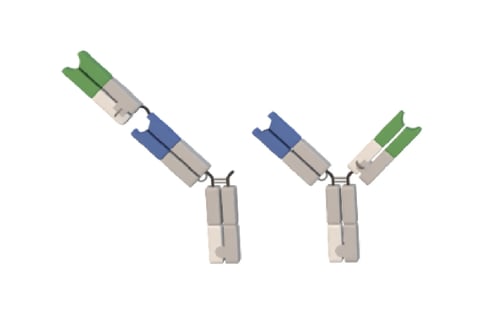
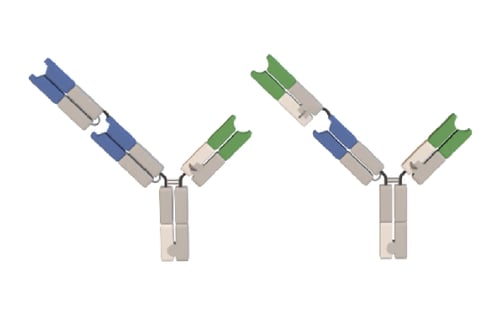
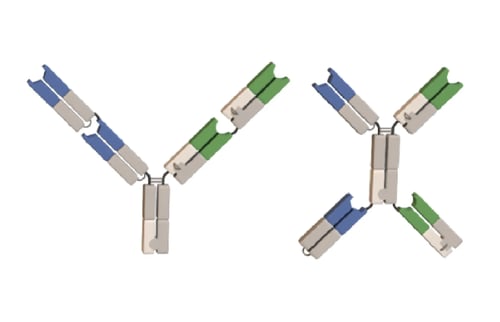
The same scaffold can build several shapes. Whether each arm binds once or twice changes how the molecule behaves, and the right choice depends on your biology. Target density, the therapeutic window, and manufacturing all drive format selection. Because the platform tests formats in parallel in their final configuration, you compare them on real data instead of guessing.
inv-BBody-1x1-1
B-Body® Bispecific 1x1
  • Key feature Monovalent binding

  • Advantage Simple, IgG-like
  • Trade-off No avidity
inv-BBody-2x1-1
B-Body® Bispecific 2x1
  • Key feature Enables bivalent binding
  • Advantage Avidity binding to one target
  • Trade-off More complex
inv-BBody-2x2-1
B-Body® Bispecific 2x2
  • Key feature Bivalent

  • Advantage Avidity to both targets
  • Trade-off More complex
t-body-features4-white
T-Body Trispecific
  • Key feature Three targets, one IgG

  • Advantage Reaches biology two arms cannot
  • Trade-off Larger design space to explore

Stages 4 to 6 Characterize, choose, then confirm

This is the front half of the workflow, and it’s the same whether you end up with a monoclonal, a bispecific, or a trispecific.

inv-icon-umbrella

Stage 4

Characterize the panel

The matrix output undergoes the same characterization as the monoclonals did, now as multispecifics. Developability, binding, and function across hundreds to thousands of candidates, in plate-based and individual assays.

inv-icon-team

Stage 5

Select the leads together

Function comes first. We start with the functional data, select the top performers, and then cross-reference them against developability. This is a working session, not a blind handoff. You see the full dataset, and we review it together because the trade-offs at this stage are program decisions rather than technical ones.

inv-icon-confirm2

Stage 4

Scale up and confirm

Nobody goes from a one-milliliter expression to a lead. Selected candidates are scaled up to meet your downstream testing requirements.

What you get A lead candidate, not just a molecule

At the end, you don’t get a sequence and a shrug. You get a novel multispecific molecule in its final format with a complete data package, ready for cell line development — so you skip format engineering and move toward manufacturing.

inv-icon-design
A characterized candidate

Human germlines, natural CDR diversity, minimal liabilities, characterized in the format you will actually develop.

inv-icon-timeline
The full data package

You get all the developability data, not a curated summary

inc-icon-antibody
Licensing

Your leads and your data are yours, provided under a research use license. Clinical / Commercial access is available.

RELATED SERVICES Dive into our platform and services

Monoclonal

mAb Discovery

A monoclonal you own outright, on its own or as the start of a multispecific.

Bispecific

B-Body® Discovery

A full bispecific program: we screen binders, build the matrix, and hand back characterized leads.

Bispecific

B-Body Express

Already have the sequences? We build, express, and characterize them in the B-Body format.

Trispecific

T-Body Discovery

A full trispecific program, on the same architecture, for three targets at once.

Science & Data

Performance Data

The yield, purity, binding, and function data behind the platforms, with the proof for every claim.

Get in touch Have a trispecific program in mind?

Tell us about it. We’ll work through whether T-Body is a fit, scope the engagement to your biology, and put together a partnership structure that works for where your program is.

Your information is 100% confidential.

We don't share your data with third parties, add you to marketing lists without permission, or contact you about anything other than this request. Target biology is treated as confidential. Need an NDA first? Just say so. We'll send one over.